✂️ Precision Synchronisation Sprockets for Grape Vine Pre-Pruners and Mechanical Hedgers
Mechanical pre-pruners and hedgers in Australian vineyards operate at the intersection of two engineering requirements that rarely appear together in agricultural machinery: they must be mechanically robust enough to drive multiple overlapping rotary blade assemblies through dense vine wood, and they must be dimensionally stable enough to maintain the phase synchronisation between blade sets that prevents blade-on-blade contact and ensures a clean, consistent cut across the full working width of the machine.
The vibration environment of a multi-blade pruning head — running at 600–900 RPM through Shiraz canes in the Barossa Valley or Cabernet in the Coonawarra — creates the specific fastener-loosening problem that vineyard managers describe as the defining maintenance headache of their mechanical pruning operations: sprocket hub bolts and taper-lock screws that back off under vibration, causing progressive timing drift between blade pairs and the blade contact events that damage both the cutting system and the vine structure.
We address this problem at the engineering level — not just by recommending thread locking compound, but by manufacturing pre-pruner sprockets with taper-lock hub geometries that develop higher clamping force at the same bolt torque, precision tooth profiles that minimise the transmission error that amplifies vibration within the drive system, and hub face runout tolerances that keep the sprocket concentric under the gyroscopic forces of the rotating blade assembly.

⚙️ How Synchronisation Works in a Multi-Blade Pre-Pruner
A multi-blade pre-pruner drives two to four pairs of counter-rotating circular saws or reciprocating blade assemblies from a common chain-and-sprocket drive. The phase relationship between each blade pair — the angular offset between the left and right blade of each cutting pair — is set by the sprocket tooth counts and the chain length at installation. This phase relationship determines the cutting gap geometry: if the blades are correctly phased, they pass each other with a clearance of 2–4 mm. If vibration-induced timing drift moves the phase relationship by even 2–3 degrees, the cutting gap closes and blade-on-blade contact occurs. The sprocket is the mechanical element that defines and maintains this phase — its tooth form accuracy and hub concentricity are the physical determinants of cutting precision.
The sprockets that drive the blade shaft bearings are the primary phase-setting elements in the pruner drive system. These must hold pitch-circle diameter to within ±0.2 mm to maintain the designed phase relationship across the full operating temperature range. Precision-ground tooth profiles manufactured to ISO 606 tooth form standard, with hub face runout verified to ±0.05 mm TIR, are the specification requirements for reliable synchronisation.
Drive the synchronisation shaft that links left and right blade drives to maintain their phase relationship across the full working width. These sprockets see lower loads than the blade drive positions but are equally critical to phase accuracy — any dimensional error in the synchronisation sprocket produces a systematic phase offset that appears as a consistent cut quality defect across every vine in the row.
Transmit hydraulic motor or PTO power into the pruner blade drive system. These positions see the highest torque in the system but are less precision-critical than the blade phase sprockets. Standard case-hardened specification with taper-lock bore is appropriate — the main input sprocket must be correctly rated for the hydraulic motor stall torque, which may be 2–3× the running torque at startup.
Drive the height and angle adjustment mechanisms that position the cutting head relative to the vine canopy. These are light-duty, low-speed drives — the specification requirement is dimensional stability and corrosion resistance (constant outdoor vineyard exposure) rather than load capacity. Stainless steel or zinc-nickel plated small sprockets are the appropriate specification for these positions.
The loosening of taper-lock bolts and hub fasteners on pre-pruner blade sprockets under vibration is not primarily a torque retention problem — it is a result of transmission error within the drive system amplifying vibration at the sprocket’s natural frequency. A sprocket with poor tooth form accuracy creates small velocity fluctuations (transmission error) as each roller engages its tooth. These velocity fluctuations create oscillatory torque at the hub interface, which progressively overcomes the friction clamping force of even a correctly-torqued fastener through a ratcheting mechanism. Eliminating the transmission error source — through precision tooth form accuracy — reduces the vibration amplitude at the hub interface by 40–60%, allowing correctly-torqued fasteners to maintain their clamping force for a full pruning season.
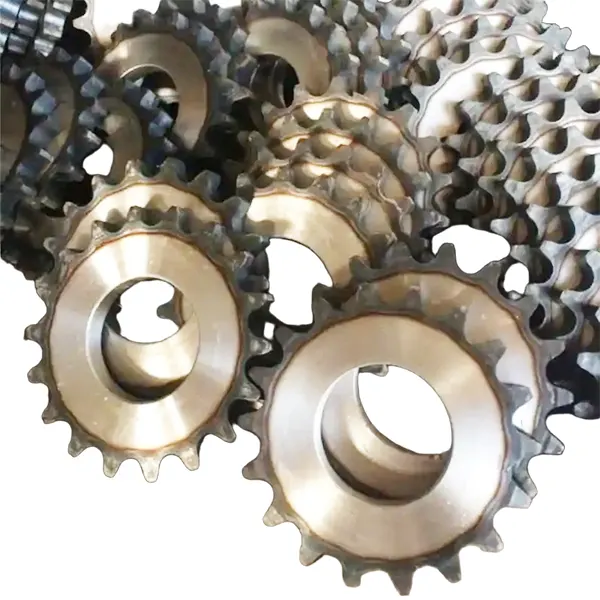
Pre-Pruner and Hedger Sprocket Specifications
| Position | Chain Standard | Tooth Form Tolerance | Hub Runout | Material | Treatment | Fastener Specification |
|---|---|---|---|---|---|---|
| Blade drive (phase-critical) | ANSI 40 or ANSI 50 | ISO 606 ±0.2 mm pitch circle | ≤0.05 mm TIR | SAE 1045 medium carbon | Case hardened HRC 48–52, precision ground | Taper-lock with thread-lock compound |
| Cross-drive synchronisation | ANSI 40 or ANSI 50 | ISO 606 ±0.2 mm pitch circle | ≤0.05 mm TIR | SAE 1045 medium carbon | Case hardened HRC 48–52, precision ground | Taper-lock with prevailing-torque nut |
| Main input / hydraulic motor | ANSI 60 or ANSI 80 | Standard ±0.5 mm | ≤0.1 mm TIR | SAE 1045 carbon steel | Case hardened HRC 45–52 | Taper-lock standard |
| Positioning / adjustment drive | ANSI 35 or ANSI 40 | Standard ±0.5 mm | Standard | 304 SS or Zn-Ni coated | Corrosion resistant | Hex socket with nyloc nut |
️ Lightweight Options Without Compromising Precision
Pre-pruner and hedger head weight is a significant operational factor in steep-slope vineyards — particularly in the Clare Valley, Eden Valley, and Great Western regions where vineyard gradients demand careful attention to machine balance and tipping risk. The blade head weight directly affects the tractor stability on cross-slope passes. We offer two lightweight approaches for pre-pruner sprockets where machine weight reduction is a priority:
- Spoked Hub Design: Our spoked-hub precision sprockets remove up to 35% of the mass of a solid-hub equivalent while maintaining the same tooth form accuracy and hub stiffness. The spoke geometry is calculated to maintain hub stiffness within 5% of the solid equivalent — the precision is not compromised by the weight reduction. These are available for ANSI 40 and ANSI 50 blade drive positions in tooth counts from 12 to 30T.
- 7075-T6 Aluminium Alloy: For the lowest-load positioning and adjustment sprockets, we manufacture from 7075-T6 aluminium alloy — 65% lighter than steel, with anodised surface finish for corrosion resistance. Aluminium sprockets are appropriate for positions below 500 N·m peak torque and below 400 RPM. They are not appropriate for the blade drive or synchronisation positions where impact shock from vine engagement occurs.
Fastener Retention System — Our Recommendation for Vibration Environments
| Fastener Type | Vibration Retention | Installation Requirement | Inspection Interval | Recommended Position |
|---|---|---|---|---|
| Standard taper-lock bolts | Moderate — adequate for low-vibration positions | Correct torque to spec | Every 50 hours | Main input and reduction positions |
| Taper-lock + thread-lock compound (medium strength) | Good — prevents gradual loosening | Apply compound, torque to spec | Every 100 hours | Blade drive synchronisation positions |
| Taper-lock + prevailing-torque nut (nyloc equivalent) | Excellent — positive torque retention | Replace nyloc at every removal | Every season | Phase-critical blade drive positions |
| Hex socket cap + serrated flange nut | Very good — serrations bite into sprocket face | Correct torque to spec | Every 100 hours | Positioning / adjustment drives |
Customer Cases
A Barossa Valley Shiraz producer running a Pellenc Optimum pre-pruner had been experiencing blade timing drift every 8–10 pruning hours, requiring mid-row stops to re-torque blade drive sprocket bolts. After switching to our precision-ground synchronisation sprockets with taper-lock and thread-lock compound, the interval extended to the full pruning season without a re-torque event. “The precision ground tooth form is what made the difference — the vibration from the old approximate-profile sprockets was what was causing the fasteners to back off. Your sprockets simply run smoother, and the fasteners stay put.” ⭐⭐⭐⭐⭐
A Clare Valley contract pruner operating on steep-slope vineyards specified our spoked-hub lightweight blade drive sprockets to reduce head weight on their modified Gregoire pre-pruner. “The 32% weight reduction from the spoked hub design measurably improved machine balance on our steeper cross-slope passes. The precision is identical to the solid hub equivalent — the cut quality from the first vine was the same as our best-performing solid hub configuration.” ⭐⭐⭐⭐⭐
A Champagne region dealer supplying synchronisation sprockets for Pellenc and New Holland Braud pre-pruners uses our precision-ground range. “The ISO 606 tooth form certificate and the hub runout measurement report you supply are the documentation our precision-agronomy vineyard customers demand. The cutting consistency improvement from correct synchronisation sprocket specification is genuinely visible in the pruning results — our customers notice it.” ⭐⭐⭐⭐⭐
An Italian vineyard machinery manufacturer uses our precision blade drive sprockets as OEM components in their pre-pruner range supplied to Alpine vineyards in steep terrain. “We specify your spoked-hub precision sprockets as the OEM component for our head weight-optimised pre-pruner model. The combination of precision tooth form and reduced mass is not available from any other supplier at comparable cost.” ⭐⭐⭐⭐⭐
A Marlborough Sauvignon Blanc operation running two Pellenc pre-pruners specifies our precision synchronisation sprockets with prevailing-torque fastener system. “Marlborough wind conditions create additional vibration loading on our pre-pruner heads. Your prevailing-torque fastener recommendation, combined with the precision tooth form, has eliminated the blade contact events we were having once per block. The vine damage reduction alone justifies the sprocket specification.” ⭐⭐⭐⭐⭐
Complete Your Vineyard Machinery Drive System
S-type, CA-type, and ANSI roller chains manufactured to the same pitch standards as our sprockets — supplied as verified matched sets.
Explore Chains →
⚡ PTO Shafts & Drivelines
T-series and wide-angle CV drivelines connecting tractor PTO power to every implement chain-and-sprocket drive we serve.
Explore Drivelines →
⚙️ Agricultural Gearboxes
Right-angle bevel and parallel-shaft gearboxes forming the upstream drive stage for PTO-powered chain systems.
Explore Gearboxes →
❓ Frequently Asked Questions
✂️ Specify Precision Pre-Pruner Sprockets for Your Vineyard
Send us your pre-pruner make, model, and current blade drive sprocket part numbers — we confirm the exact tooth count, bore, and tooth form specification and supply with ISO 606 profile certificates and hub runout measurement reports. Spoked-hub lightweight options available. 30–50% below OEM pricing.