Long-Life Sprockets for TMR Feed Mixer Drives — Engineered for 365-Day Continuous Operation
Total mixed ration (TMR) feed mixers are the central tool of intensive livestock production in Australia’s feedlots, dairies, and sheep enterprises. Unlike seasonal agricultural machinery, a TMR mixer runs every single day of the year — typically two to four mixing and delivery cycles per day, 365 days per year. A feedlot running 5,000 head of cattle cannot pause feeding while a mixer drive sprocket is sourced and replaced. The chain-and-sprocket drives inside a TMR mixer must last, must resist the corrosive chemistry of mixed silage, grain, and liquid supplements, and must be available as replacements when maintenance intervals require them.
We manufacture TMR feed mixer sprockets to the specific material and surface treatment standards demanded by this continuous-duty application — corrosion-resistant coatings for the organic acid environment of silage-dominant rations, wear-resistant tooth hardness for the abrasive dry components of grain and hay, and exact OEM tooth form matching to prevent the accelerated chain-sprocket meshing wear that occurs when mismatched tooth profiles run against each other in a heavily-loaded drive.
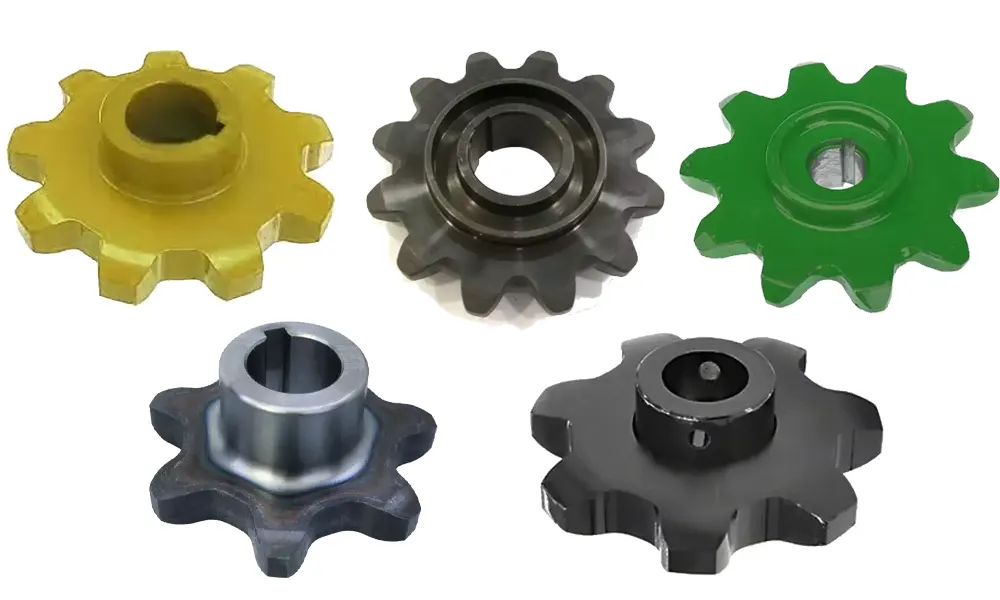
⚙️ TMR Mixer Drive Positions and Their Specific Sprocket Requirements
Drives the primary vertical or horizontal mixing auger that blends silage, grain, hay, and supplements into the finished ration. This is the highest-load, highest-duty cycle sprocket on the machine. The auger drive runs continuously through each mixing cycle — typically 8–12 minutes of full-load operation — with brief stops between loads. The tooth flanks are subjected to sustained rolling contact under high torque in an environment rich in organic acids from silage fermentation.
Drive the floor apron chain or discharge conveyor that moves the finished ration out of the mixing chamber and into the feed bunk. These sprockets run at lower speed than the auger drive but are in direct contact with the mixed ration — including the organic acid, moisture, and abrasive grain particles of the finished TMR. Corrosion resistance at the tooth surface is the primary specification requirement for discharge conveyor sprockets.
The input chain drive from tractor PTO or hydraulic motor to the main mixer jackshaft. These positions see the full input torque and run at higher speed than the auger and conveyor drives. Standard case-hardened carbon steel with phosphate coating is typically adequate at this position where direct ration contact is minimal.
Side-discharge conveyors and supplementary belt drives on large TMR mixers. These positions run in mixed ration spray and fine particle dust from the discharge process. Corrosion protection and sealed tooth form (to prevent ration particle packing) are the key specifications.
The most common premature failure mode we observe in TMR mixer chain-sprocket drives is not wear of the tooth flanks but progressive pitch mismatch between the chain and sprocket. This occurs when a replacement sprocket with a slightly incorrect tooth form is installed — either because the manufacturer used an approximated tooth profile rather than the correct ISO 606 form, or because worn chain is run against a new sprocket. As the pitch mismatch accumulates, the chain engages the sprocket tooth at a contact point progressively higher on the tooth face rather than at the designed pitch-circle contact. This high-contact mode concentrates the roller impact load on a smaller area, accelerating both tooth flank wear and chain roller wear simultaneously. The result is that both the new sprocket and the existing chain wear out in a fraction of their individual service lives.
Why Australian Feedlot and Dairy Conditions Are Particularly Demanding
Australian intensive livestock operations — particularly Southern Australian dairy farms and Queensland feedlots running high-grain finishing rations — frequently formulate TMR rations with 30–60% silage inclusion by weight. Well-fermented whole-plant maize silage has a pH of 3.8–4.2 — highly acidic relative to most agricultural environments. The auger drive and discharge conveyor sprockets operate continuously in the vapour and liquid phase of this chemistry. Standard bare carbon steel sprockets corrode measurably within 3–6 months of continuous silage-contact operation. Phosphate-coated, zinc-nickel, or stainless steel specification extends this interval to years.
Australian feedlot TMR mixers typically operate outdoors in full sun at ambient temperatures of 32–42°C in summer. At these temperatures, any lubricant that has migrated onto the sprocket tooth flanks from the chain evaporates or oxidises rapidly, leaving the contact surfaces with minimal lubrication film. Sprockets that rely on lubricant film for their effective wear resistance perform poorly in Australian feedlot summer conditions — case-hardened or induction-hardened tooth flanks that provide mechanical rather than lubricant-dependent wear resistance are the correct specification.
A feedlot TMR mixer completing 4 cycles per day accumulates 1,460 mixing cycles per year. The main auger drive sprocket engages and disengages load 1,460 times per year at full rated torque — far more than any seasonal agricultural machine. This cycle-based fatigue accumulation requires that sprockets be assessed on annual cycle count rather than total hours, and replacement intervals planned accordingly.
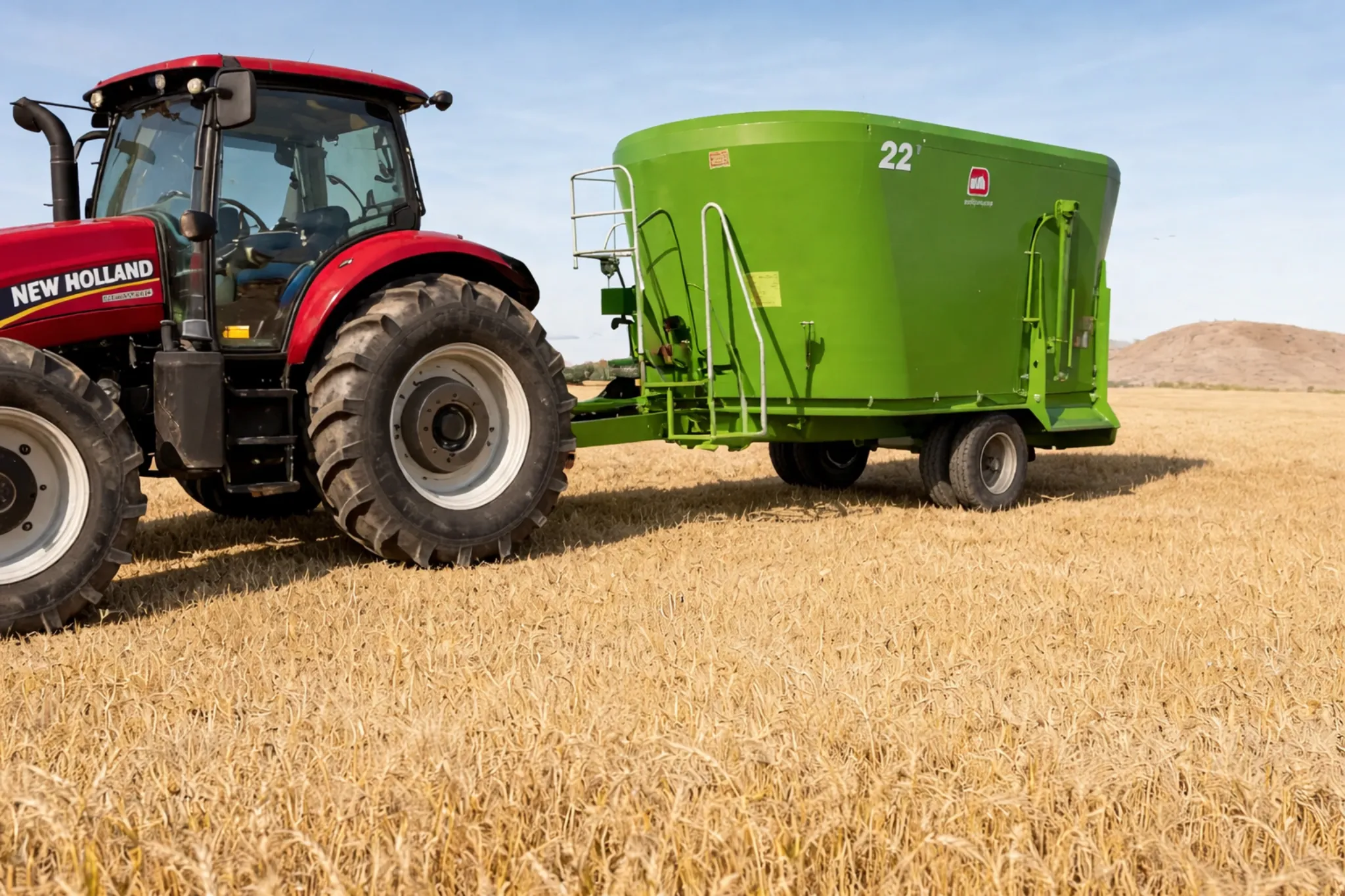
TMR Feed Mixer Sprocket Specifications
| Position | Chain Standard | Typical Teeth | Material | Surface Treatment | Corrosion Rating | Service Interval Target |
|---|---|---|---|---|---|---|
| Main auger drive (heavy, 12–22m³) | ANSI 100 or ANSI 120 double-strand | 11–21T | SAE 4140 alloy steel | Induction hardened + phosphate coat | Good (phosphate) | 12–18 months |
| Main auger drive (medium, 6–12m³) | ANSI 80 double-strand | 13–24T | SAE 1045 carbon steel | Case hardened + phosphate or Zn-Ni | Good–Excellent | 18–24 months |
| Discharge conveyor drive | ANSI 60 or ANSI 80 | 13–21T | 304 SS or Zn-Ni coated C-steel | SS or Zn-Ni electroplated | Excellent (SS/Zn-Ni) | 24–36 months |
| PTO input / jackshaft | ANSI 80 or ANSI 100 | 15–30T | SAE 1045 carbon steel | Case hardened + phosphate | Good | 24 months |
| Secondary conveyor | ANSI 60 single-strand | 13–21T | SAE 1045 or 304 SS | Phosphate or SS | Good–Excellent | 24 months |
️ Corrosion Treatment Selection Guide for TMR Environments
| Ration Composition | pH at Sprocket Surface | Recommended Treatment | Expected Service Life | Notes |
|---|---|---|---|---|
| Dry ration (grain-dominant, low silage) | 6.5–7.0 (neutral) | Phosphate coat + case hardened | 24–36 months | Standard spec adequate — focus on wear resistance |
| Mixed ration (30–50% silage) | 5.0–6.0 (mildly acidic) | Zinc-nickel electroplated | 30–48 months | Significant improvement over phosphate in acid |
| High-silage ration (50–70% silage) | 4.0–5.0 (moderately acidic) | 304 Stainless Steel (discharge conveyor) | 60+ months | SS for direct-contact positions; Zn-Ni for indirect |
| Maize silage dominant (>60% maize silage) | 3.8–4.5 (highly acidic) | 316 SS or 304 SS (all ration-contact positions) | 60+ months | Most aggressive chemistry — only SS provides multi-year life |
Specifying the Right TMR Mixer Sprocket: Key Decisions
The silage percentage in your ration determines the pH at the sprocket surface and therefore the minimum corrosion resistance specification. Operations running more than 40% silage inclusion should specify at minimum zinc-nickel plated sprockets for the discharge conveyor and auger drives. Operations running more than 60% silage, or maize silage specifically, should specify 304 stainless for all ration-contact positions.
TMR mixer auger chains are typically ANSI 80 or ANSI 100 double-strand. Confirm the chain standard before ordering the replacement sprocket — not just the chain pitch, but the roller diameter and inner width. A sprocket manufactured to ANSI 80 nominal dimensions but with an incorrect tooth form will produce the meshing failure mode described above within 3–6 months of installation.
The hub keyway in a TMR mixer main auger drive sprocket accumulates fretting wear from the very high annual cycle count. When replacing the sprocket, inspect the shaft keyway for wear — a worn shaft keyway with a new sprocket creates a loose fit that generates progressive keyway damage. If the shaft shows keyway wear of more than 5% of keyway width, have the shaft repaired before installing the new sprocket.
For feedlot and dairy operations running 365 days per year, the main auger drive sprocket should be included in the annual shutdown maintenance budget as a conditional replacement item — measure tooth wear annually and replace if tooth height has reduced more than 10% from nominal, regardless of whether failure has occurred. Replacing a worn-but-functional sprocket during a planned shutdown is dramatically less costly than replacing a failed sprocket during a production day.
Our Manufacturing Commitment to Continuous-Duty Agricultural Applications
We have been manufacturing sprockets for continuous-duty agricultural applications since 2003. Our understanding of the specific demands of 365-day livestock feeding equipment informs every specification decision in our TMR mixer range:
- ISO 606 Tooth Form as Production Standard: Every TMR mixer auger drive sprocket is CNC-profiled to ISO 606 tooth form — not an approximation. This tooth form accuracy is the foundation of correct chain-sprocket meshing and the prevention of the pitch-mismatch failure mode described above.
- Stainless Steel Manufacturing Capability: We manufacture 304 and 316 stainless steel sprockets in ANSI and metric pitch standards from our own stainless steel machining line — not sourced from a third-party manufacturer. Material certificates with confirmed chromium and molybdenum content are standard with every stainless order.
- 20+ Years Supplying Livestock Equipment Manufacturers: We supply OEM sprocket sets to feed mixer manufacturers in China, Europe, and North America — giving us direct knowledge of the design requirements for each position. This OEM experience informs our aftermarket sprocket specification in ways that pure aftermarket manufacturers cannot access.
- No Minimum Order for Replacement Sprockets: Feedlots and dairy operations need replacement sprockets immediately when planned maintenance is scheduled. We supply single sprockets with no minimum order quantity, dispatching within the same week for all standard specifications.
Customer Cases
A 6,000-head Darling Downs feedlot running two large TMR mixers on a four-cycles-per-day schedule was replacing main auger drive sprockets every 8 months — below the 12-month target. Analysis showed the replacement sprockets being used had an approximated tooth form that was producing the pitch-mismatch failure. After switching to our ISO 606 precision-profiled induction-hardened sprockets, service life extended to 18 months on the same duty cycle. “The tooth form difference was invisible to us when we installed it — but the meshing wear pattern after 6 months on your sprockets was completely clean compared to what we had been seeing.” ⭐⭐⭐⭐⭐
A Gippsland dairy running 700 cows on a three-times-daily TMR program specified our 304 stainless discharge conveyor sprockets after persistent corrosion-driven failure of carbon steel equivalents in their high-silage-inclusion ration. “We run 65% maize silage inclusion — the chemistry inside that mixer is very acidic. Your 304 SS sprockets have now been running for 28 months on the discharge conveyor without any surface degradation. That is a result we have never achieved with carbon steel, even with frequent re-coating.” ⭐⭐⭐⭐⭐
A South Island sheep dairy running a Peecon TMR mixer on continuous daily feeding sources our zinc-nickel plated auger drive sprockets. “The Zn-Ni finish handles the mixed ration chemistry far better than the phosphate-coated sprockets we previously used. We are now on a 24-month replacement cycle for the auger drive — previously it was every 10 months. That improvement pays for several years of premium specification.” ⭐⭐⭐⭐⭐
A 2,400-cow Danish cattle farm running three Trioliet TMR mixers sources our full auger and conveyor sprocket range. “Your documentation standard — ISO 606 tooth form certificate, material test certificate, hardness report — satisfies our farm’s quality management system for maintenance parts. At 40% below Trioliet OEM pricing, you are by far the most competitive certified-quality option we have found.” ⭐⭐⭐⭐⭐
A California 4,000-cow dairy running six Kuhn Primor TMR mixers on five-cycles-per-day feeding sources all sprockets from us in zinc-nickel plated specification. “The supply consistency is what keeps us with you. Same specification, same dimensions, same documentation, every order. In a 365-day operation, a sourcing surprise on a maintenance part is not acceptable — we have had zero surprises in three years of ordering from your company.” ⭐⭐⭐⭐⭐
Complete Your Feed Mixer Drive System
S-type, CA-type, and ANSI roller chains manufactured to the same pitch standards as our sprockets — supplied as verified matched sets.
Explore Chains →
⚡ PTO Shafts & Drivelines
T-series and wide-angle CV drivelines connecting tractor PTO power to every implement chain-and-sprocket drive we serve.
Explore Drivelines →
⚙️ Agricultural Gearboxes
Right-angle bevel and parallel-shaft gearboxes forming the upstream drive stage for PTO-powered chain systems.
Explore Gearboxes →
❓ Frequently Asked Questions