Description
Rotary Cutter Gearbox EP26
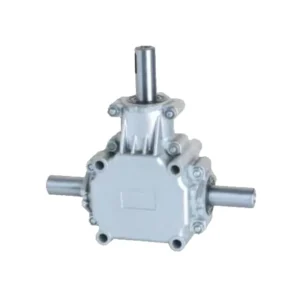
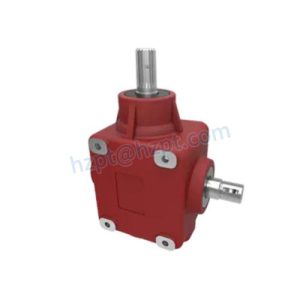
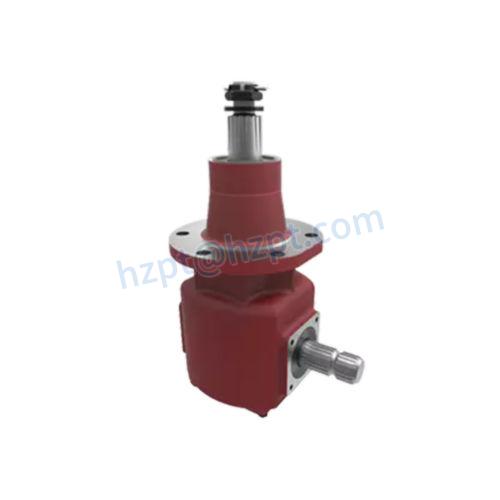
Rotary Cutter Gearbox for Rotary Cutter / Brush Cutter — model EP26.
Detailed Technical Specifications — EP26
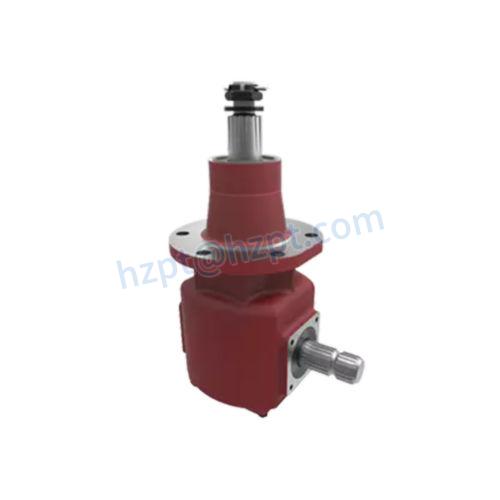
The Rotary Cutter Gearbox EP26 is engineered as a rotary cutter gearbox for rotary cutter / brush cutter applications. Designed to transfer 90° PTO power to the horizontal cutter blade shaft, the unit covers 25–100 HP input ratings and is built for high-impact intermittent loads from brush and saplings.
| Série / Modèle | EP26 |
|---|---|
| Application | Rotary Cutter / Brush Cutter |
| Rapport de transmission | 1:1 to 1:1.46 |
| Vitesse d'entrée (tr/min) | 540 RPM / 1000 RPM (selectable) |
| Arbre d'entrée | 1 3/8″ 6 cannelures (prise de force standard) |
| Arbre de sortie | Hollow shaft with shrink disk |
| Gear Accuracy Grade | ISO 1328 grade 6 |
| Gear Tooth Finish | Shaved + heat-treated |
| Bearing Type (Input) | Spherical roller bearing |
| Bearing Type (Output) | Tapered roller bearing pair |
| Bearing Brand Reference | HRB / LYC / domestic premium |
| Bearing Design Life | L10h ≥ 10,000 h |
| Lubrication Type | Oil-bath splash lubrication |
| Oil Capacity | 1.5 L |
| Oil Drain | Magnetic drain plug |
| Bouchon de ventilation | Top-mount vented breather |
| Type de joint | Combinaison anneau en V + joint squelette |
| Protection contre les infiltrations | IP67 (submersible-rated seals) |
| Température de fonctionnement | -30 °C to +90 °C |
| Niveau sonore (à vide) | ≤ 72 dB(A) |
Engineering Features of the Rotary Cutter Gearbox
Each of the cards below describes a specific, measurable attribute of the EP26 unit. Generic claims have been kept out — every number here is tied to a manufacturing process or a verified test result.
Compatibilité et références croisées
The EP26 is designed as a drop-in or close-substitute fit for a number of OEM gearbox positions used on tractors and rotary cutter / brush cutter implements globally. The table below summarizes commonly cross-referenced brands. Final fitment must be verified by physical dimension matching.
| Marque | Gamme d'équipements | Notes |
|---|---|---|
| Maschio Gaspardo | motoculteurs et semoirs | référence croisée ; vérifier les dimensions de la bride et de l’arbre |
| AGCO | tracteurs multimarques | référence croisée ; vérifier les dimensions de la bride et de l’arbre |
| Massey Ferguson | tractors and hay tools | référence croisée ; vérifier les dimensions de la bride et de l’arbre |
| Kverneland | tillage and seeding machinery | référence croisée ; vérifier les dimensions de la bride et de l’arbre |
| Pottinger | forage equipment | référence croisée ; vérifier les dimensions de la bride et de l’arbre |
| John Deere | tractors and PTO implements | référence croisée ; vérifier les dimensions de la bride et de l’arbre |
Pièces de rechange disponibles (vendues séparément)
- Bouchon de vidange (magnétique)
- joint de bride de montage
- Boîtier de remplacement (HT250)
- Bolt and washer kit
- Input pinion sub-assembly
- Output bevel gear
How to Select the Right Rotary Cutter Gearbox
Use the three-step approach below to match a EP26-class unit to your tractor and implement.
- Mesure — notez la norme de votre prise de force de tracteur (540 / 1000 tr/min, nombre de cannelures), le diamètre et la longueur de l'arbre d'entrée de l'outil, ainsi que le schéma de boulonnage disponible au niveau du nez de l'outil.
- Correspondre — cross-check those measurements against the spec table for the EP26. The flange, shaft, and ratio need to all line up before moving on.
- Vérifier sous charge — vérifiez que la puissance d'entrée nominale et le couple de sortie sont suffisants pour vos conditions de fonctionnement optimales (par exemple, sol humide, culture dense, démarrage à froid).
liste de contrôle des critères de sélection
| Critère de sélection | Points de décision |
|---|---|
| Implémenter la correspondance de type → ratio | For rotary cutter / brush cutter, target gear ratio in the 1:1 to 1:1.46 range for correct rotor or output speed. |
| bande de puissance du tracteur | Match input power rating to your tractor: 25–100 HP is the practical envelope for the EP26 family. |
| Vitesse de prise de force (540 contre 1000 tr/min) | Le régime de 540 tr/min est la norme pour les tracteurs de moins de 100 ch ; 1 000 tr/min est préférable pour les machines de plus de 100 ch et lorsque des vitesses de rotation plus élevées sont requises. Vérifiez la vitesse de la prise de force du tracteur avant de faire votre choix. |
| Matériau du boîtier | Fonte (HT250 / QT500) pour un usage intensif et continu ; alliage d'aluminium lorsque la réduction du poids et la dissipation rapide de la chaleur sont importantes, par exemple pour les petits outils déplacés fréquemment. |
| Mise en page | Les unités à angle droit (90°) redirigent la puissance de la prise de force vers un arbre de travail perpendiculaire ; les unités en ligne conservent l’alignement de l’arbre. Choisissez en fonction de la géométrie de l’outil. |
| Standard vs personnalisé | Les modèles standard couvrent la plupart des positions des équipementiers. Pour des rapports non standard, des extrémités d'arbre spéciales, des brides surdimensionnées ou des spécifications pour environnements difficiles, veuillez demander une fabrication sur mesure. |
| interface d'extrémité d'arbre | Vérifiez la norme de la prise de force d'entrée (6 cannelures, 21 cannelures, 20 cannelures) et l'extrémité de sortie (clavetée, cannelée, à bride) par rapport à votre transmission et à votre outil. |
| Environnement de travail | Une forte concentration de poussière, de boue, d'embruns salés ou un froid extrême peuvent nécessiter des joints d'étanchéité IP66, une huile synthétique basse température ou une finition anticorrosion — à préciser lors de la demande de devis. |
Applications typiques et tâches de transmission de puissance
The EP26 is engineered for rotary cutter / brush cutter. The scenarios below describe the specific power-transmission tasks the gearbox is designed to handle, with details of mounting position, drive path, and the technical demand on the gear and bearing set.
Orchard Mulcher
Mulches prunings between rows. The gearbox must accept frequent stops/starts as the operator navigates trees, with no torque-reversal damage to the bearings or gears.
Rotary Brush Cutter
Mounted on the deck of 3-point hitch slashers, the gearbox transmits PTO power 90° to the horizontal blade carrier. Shock loads from saplings up to wrist thickness make peak torque capability the primary selection criterion.
Pasture Topper
Lighter-duty mowing of weeds and unwanted growth on pasture land. Continuous-duty rotor speed of around 540 RPM at the spindle, sustained over hours, demands a high-efficiency gear set that runs cool.
Highway / Roadside Mower
Operated on offset booms by municipal contractors. Vibration and impact loads are higher than ag use; the EP26 housing absorbs these without distortion.
Guide d'installation et de mise en service
Correct installation of the rotary cutter gearbox is the single biggest factor in achieving the design service life. Follow the steps below, in order. Skipping or compressing any step usually shows up as oil leak, premature bearing failure, or noise within the first season.
- Préparation en matière de sécurité. Coupez le moteur du tracteur, retirez la clé, désengagez la prise de force, serrez le frein de stationnement et calez les roues. Portez des gants et des lunettes de sécurité. Avant toute intervention sur la transmission, assurez-vous que l'outil repose sur des supports stables.
- Vérifiez la boîte de vitesses avant le montage. Check that the EP26 model number, input flange dimensions, and input/output shaft specifications match both your tractor PTO and the implement input shaft. Mismatched flange or spline patterns will not be corrected by force-fitting.
- Remplir de lubrifiant. Before first use, fill with the specified lubricant — typically SAE 90 GL-4 — to the centre of the oil-level window. Refer to the spec table for the exact oil capacity for your unit; underfilling causes early bearing wear, overfilling raises oil temperature and stresses seals.
- Montez les boulons et serrez-les au couple prescrit. Bolt the gearbox flange to the implement using the OEM bolt set. Tighten in a diagonal pattern in three passes to the final torque (~ 140 N·m for M16 grade 8.8). Even loading prevents flange distortion and seal leak paths.
- Raccordez l'arbre de prise de force d'entrée. Fixez le joug de l'arbre de prise de force à l'arbre d'entrée de la boîte de vitesses. Vérifiez que la goupille de verrouillage ou la bague de serrage est bien enclenchée. Remontez le carter de sécurité en fixant les deux chaînes de retenue au tracteur et à l'outil, sans qu'elles ne tournent avec l'arbre.
- Raccordez l'arbre de sortie. Enfoncez l'arbre de sortie dans l'arbre de travail de l'outil, alignez les clavettes ou les cannelures et bloquez-le avec l'écrou et la rondelle de retenue fournis. Vérifiez que le jeu axial de l'arbre est conforme aux tolérances du fabricant (généralement de 0,05 mm à 0,20 mm).
- Vérifier l'alignement de l'arbre. Une fois le réducteur boulonné et les arbres connectés, faites-le tourner lentement à la main. Le faux-rond total (TIR) à l'entrée et à la sortie ne doit pas dépasser 0,10 mm. Tout point dur ou grincement audible indique un problème d'alignement qui doit être corrigé avant la mise en marche.
- Test à vide. Enclenchez la prise de force à bas régime moteur (ralenti à 540 tr/min) pendant cinq à dix minutes. Soyez attentif à tout bruit inhabituel, vérifiez l'absence de suintement d'huile et contrôlez la température du carter à la main : il doit être tiède au toucher, sans être brûlant.
- Rodage sous charge partielle. Pendant les 50 premières heures de fonctionnement, évitez la pleine charge nominale. Variez légèrement la vitesse et la charge pour roder les engrenages et les roulements. Après cette période, vidangez l'huile (qui contient des particules microscopiques de rodage) et remplacez-la par de l'huile neuve de même grade.
- Établir un calendrier d'entretien. Vérifiez le niveau d'huile toutes les 200 heures de fonctionnement ou chaque semaine en cas d'utilisation intensive. Vidangez et remplacez l'huile d'engrenage toutes les 500 heures ou une fois par saison, selon la première échéance. Essuyez l'extérieur du carter après chaque utilisation pour éviter l'accumulation de saletés qui pourraient retenir l'humidité au niveau des joints.
Our Rotary Cutter Gearbox vs. Low-Quality Alternatives
Not every gearbox sold as an “agricultural” unit is engineered for the job. The dimensions below compare the EP26 class build to the typical low-cost imported alternative.
| Dimension | Unité de mauvaise qualité | Notre construction | Avantages pour l'utilisateur |
|---|---|---|---|
| Assistance après-vente | Vente uniquement aux distributeurs, aucun contact avec les ingénieurs | Assistance directe du fabricant, réponse technique sous 24 heures | Résolution plus rapide en cas de problème sur le terrain. |
| Matériel d'équipement | Acier 45# brut, sans traitement thermique | 20CrMnTi, carburized & quenched, HRC 58–62 surface | Durée de vie des engrenages triple sous des charges de prise de force typiques. |
| Matériau du boîtier | Fonte grise HT150 à paroi mince, sujette aux fissures | QT450, épaisseur de paroi ≥ 8 mm, résistance à la traction ≥ 250 MPa | Résiste aux chocs des roches et des souches sans rupture structurelle. |
| Précision de l'engrenage | Fraise à tailler uniquement, classe 9 ISO 1328 | Rectifié CNC, classe 6 ISO 1328, bruit ≤ 72 dB(A) | Fonctionnement plus silencieux et durée de vie accrue. |
| Niveau de roulement | Sans marque, aucune note publiée | Roulements à rouleaux coniques haut de gamme, L10h ≥ 10 000 h | Durée de vie prévisible sous charge nominale. |
| Oil seals | Single-lip rubber, hardens and leaks within months | Double-lip skeleton seal with PTFE wear face, IP65 | Lubricant stays in, dust and water stay out. |
| Mesh efficiency | < 90%, runs hot under load | ≥ 97% for spiral bevel mesh, temperature rise ≤ 35 °C | More tractor HP reaches the implement; less wasted as heat. |
| Dynamic balance | Not measured | Rotor groups balanced to ISO G6.3 | Eliminates vibration-driven bearing failure. |
| Backlash control | Hand-fit, inconsistent unit-to-unit | Jig-set to ±0.02 mm at assembly | Smooth tooth contact, predictable drive feel. |
Foire aux questions
Common questions from buyers evaluating the EP26 for their fleet or implement build. If your situation is not covered, send us the details and we will respond within one working day.
Quand dois-je spécifier une entrée de 540 tr/min plutôt qu'une entrée de 1000 tr/min ?
Do you offer OEM and custom-spec gearboxes? What are the minimums?
What is your warranty policy and how do I make a claim?
What certifications do you hold and is your product suitable for Australian farms?
How long is the lead time for a stock order vs. a custom build?
Retours clients du terrain
Selected feedback from operators using the EP26 or related units in commercial rotary cutter / brush cutter duty across multiple countries. Names are anonymized using city + initials for privacy.
Produits complémentaires et accessoires de transmission
A rotary cutter gearbox usually sits in the middle of a longer drivetrain. The items below complete the typical agricultural power-transmission package.
Certifications & Quality Standards
- ISO 9001:2015 — Quality management system covering design, manufacturing, and inspection processes.
- ISO 6336 — Reference standard for the load-capacity calculation of cylindrical and bevel gears.
- DIN 3960 / DIN 3961 — Tooth profile and accuracy class definitions used for gear quality grading.
- EN ISO 11684 — Pictorial safety signs and warning marks for agricultural machinery.
- CE marking — Conformity with the EU Machinery Directive 2006/42/EC where applicable.
- AS 4024 — Australian machinery safety framework — referenced for OEM units bound for AU farms.
- Material certification — Mill certificates for gear and shaft alloys; hardness, composition, and metallographic data on file per batch.
Outgoing Inspection Workflow
Each batch passes through: incoming raw-material inspection → forging and machining first-article check → heat-treatment hardness sample test → gear-accuracy measurement on Klingelnberg-class testers → assembly torque verification → no-load run-in and acoustic record → final visual and packaging check. Inspection records travel with the carton.
Notes for Australian Buyers
Units shipped into Australia for use on commercial farms should be reviewed against the relevant state WHS (Work Health and Safety) requirements and the rotary cutter gearbox fitted with all guards specified by the implement OEM. Common search terms used by Australian buyers include agricultural gearbox Australia, farm gearbox supplier Australia, Queensland tractor parts, NSW farm equipment, and Victoria agricultural machinery — let us know your state and intended implement and we will recommend the matching configuration.
Why Buy from Us — Factory & Brand Strength
Factory background
We have been manufacturing agricultural gearboxes including the rotary cutter gearbox family at our facility for over a decade. The plant covers a substantial machining and assembly area with dedicated heat-treatment, gear-cutting, gear-grinding, and final-assembly bays, and a year-round skilled workforce in production and quality.
Production capability
Annual capacity covers tens of thousands of units across the catalogue. Critical equipment includes CNC gear-hobbing centres, CNC gear-grinders, sealed-quench heat-treatment furnaces, three-coordinate measuring machines (CMM), gear-tooth contact testers, and dedicated run-in test stands. Tooling and dies for the most popular models are kept on standby to cut response time on repeat orders.
Export footprint
We currently export to dozens of countries, with primary markets in Australia, North America, Europe, and Southeast Asia. Common search terms used by international buyers include agricultural gearbox manufacturer China, custom farm gearbox supplier, and OEM gearbox factory — and our sales team is set up to handle drawing reviews and technical conversations in English.
OEM / ODM capability
Our standard custom flow is: drawing or sample submission → engineering review and quote → 3D model and prototype tooling sign-off → first-article sample → small pilot batch → serial production. Lead times for new tooling typically run 30–60 days; repeat builds run inside 20–30 days.
MOQ & lead time
Standard catalogue models: MOQ from one carton (5–50 units depending on size). Custom builds: typical MOQ 50 units. Standard lead time 7–15 days for stock items, 30–45 days for custom first runs.
Quality control
Each batch passes through ISO 9001:2015 governed inspection, raw-material composition and hardness testing, in-process gear accuracy verification, final assembly torque sign-off, and a 30-minute no-load run-in test recorded per unit.
After-sales
12-month standard warranty on workmanship; extended warranty for OEM contracts. Technical email response inside 24 hours, and replacement parts dispatched within working days for valid warranty cases.
Ready to spec your fleet?
Tell us your tractor model, implement type, and quantity needed — we will respond inside 24 hours with a quote and lead time.
We do more than supply standard agricultural gearboxes. Bring us your drawings, samples, or even a rough sketch — our engineering team will design and manufacture a precision gearbox solution tailored to your exact application.
⏱️ We respond within 24 hours · ️ 12-month standard warranty · ISO 9001:2015 certified production · Years of agricultural gearbox export experience including direct shipments to Australia.