ANSI and BS Standard Sprockets for Grape Harvesters, Nut Harvesters, and Specialty Crop Machines
Australia’s specialty crop harvesting sector — wine grape regions from the Barossa Valley and McLaren Vale to the Hunter Valley and Swan Valley, almond and hazelnut orchards across the Riverland and Sunraysia, and macadamia operations in Queensland’s hinterland — runs a remarkably diverse fleet of harvesting machinery. American-built grape harvesters running ANSI chain standards work alongside European machines built to BS (British Standard) or DIN specifications. Older machines may use metric pitch chain that no longer appears in standard catalogues. The result is a parts matching problem that frustrates machinery managers, delays harvest repairs, and often ends with a machine parked because no one can identify the correct replacement sprocket with confidence.
We carry both ANSI and BS-standard sprockets across the full tooth count range used in specialty harvesters — and our engineering team specialises in cross-standard matching from worn samples, photographs, or OEM part numbers from any brand. We have matched replacement sprockets for American, European, Italian, French, and Australian-assembled specialty harvesters in a market that our customers tell us is chronically under-served by standard agricultural parts distributors.
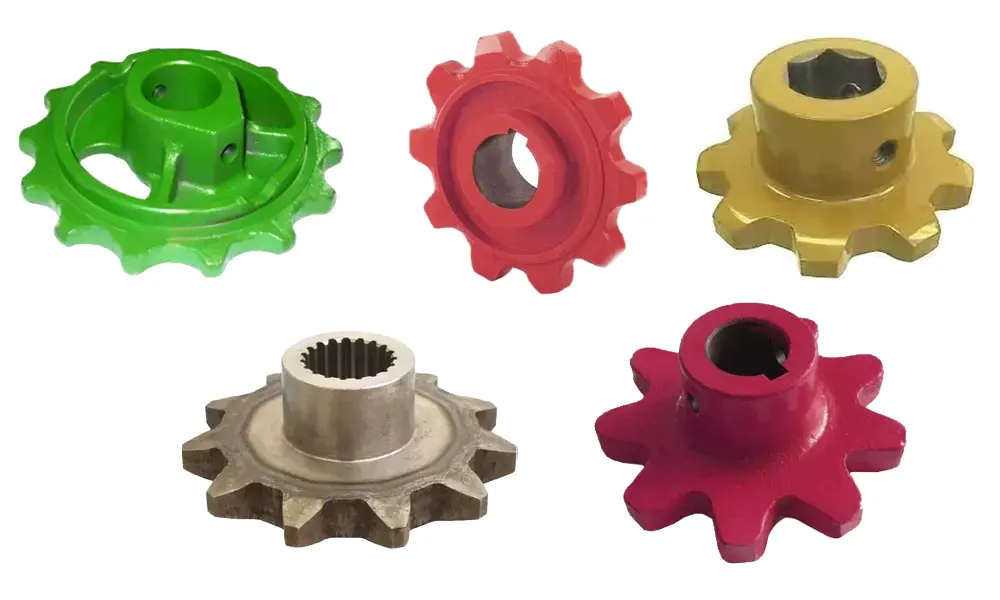
⚙️ Drive Positions in Specialty Harvesters and Their Standard Confusion Problem
The shaker arm drive on a straddler-type grape harvester typically uses ANSI 40 or ANSI 50 single-strand chain on American-built machines, and ISO/BS 08B or 10B on European machines. The same harvester may have been sold in Australia with a mix of American and European sub-assemblies — making the chain and sprocket standard different on the left and right side drives of the same machine. This is not a hypothetical problem: it is documented by Australian vineyard machine managers who have tried and failed to source matching replacements.
The collection belt conveyor and bucket elevator on grape harvesters run at moderate speed with food-adjacent exposure to grape must and juice. Food-safe or stainless sprocket specification is required for positions in direct must contact. Both ANSI 50/60 and BS 10B/12B configurations exist depending on harvester brand and age.
The drives for individual row-crop harvesting units — brush roll drives, vibrating tine drives, and transfer conveyors — on nut and specialty harvesters use a wide range of small sprocket configurations, often ANSI 35, ANSI 40, or metric pitch (8M, 10M). These positions require the highest dimensional accuracy per sprocket — mismatched tooth profiles in small sprockets cause noise, vibration, and accelerated wear that affects the quality of the harvested product.
Cleaning fan drives on grape and nut harvesters typically use ANSI 60 or ANSI 80 double-strand at the fan input shaft. These positions are less subject to the standard-confusion problem than the row-unit drives, but the food-adjacent environment requires attention to lubricant specification.
ANSI (American National Standard) and BS (British Standard) roller chains have similar but not identical pitch dimensions. ANSI 50 chain has a 15.875 mm pitch and 9.53 mm roller diameter. BS 10B chain has a 15.875 mm pitch but a 10.16 mm roller diameter — the same pitch, different roller. A BS 10B sprocket has a tooth form designed for the 10.16 mm roller. If you run ANSI 50 chain on a BS 10B sprocket (or vice versa), the roller seats incorrectly in the tooth form, creating concentrated contact stress that wears through the tooth face in a fraction of the normal service life. The fact that the chains appear to fit and run quietly does not mean the specification is correct — the damage accumulates invisibly until sudden failure.
ANSI vs BS Specification Comparison for Specialty Harvester Chains
| ANSI Chain | ANSI Pitch (mm) | ANSI Roller Dia. (mm) | Nearest BS Equivalent | BS Roller Dia. (mm) | Interchangeable? | Note |
|---|---|---|---|---|---|---|
| ANSI 35 | 9.525 | 5.08 | BS 06B | 6.35 | ❌ No | Different roller and pitch — not interchangeable |
| ANSI 40 | 12.70 | 7.92 | BS 08B | 8.51 | ❌ No | Same pitch, different roller diameter |
| ANSI 50 | 15.875 | 10.16 | BS 10B | 10.16 | ⚠️ Partial | Same roller dia. but check inner width before assuming compatibility |
| ANSI 60 | 19.05 | 11.91 | BS 12B | 12.07 | ❌ No | Similar pitch, different roller diameter |
| ANSI 80 | 25.40 | 15.88 | BS 16B | 17.02 | ❌ No | BS 16B has larger roller — significant geometric difference |
Brand-to-Standard Reference Guide for Australian Specialty Harvesters
| Brand | Origin | Typical Chain Standard | Common Drive Positions | Notes |
|---|---|---|---|---|
| New Holland Braud VX7 | France | ISO/BS 10B and 12B | Shaker, collection belt, elevator | French manufacture — predominantly BS/ISO standard |
| Gregoire G series | France | ISO/BS 08B and 10B | Row unit, transfer, fan drive | Some newer models use ANSI for Australian market |
| Pellenc Optimum | France | ISO/BS 08B–12B | All drive positions | Confirm standard per model year |
| Oxbo / Korvan | USA | ANSI 40, 50, 60 | Row unit, elevator, fan drive | American manufacture — ANSI standard throughout |
| Alma | Spain | ISO/BS 10B–16B | Shaker arm, elevator | Spanish manufacture — European BS/ISO standard |
| Doris / Sunview (Nut) | USA | ANSI 40–80 | Nut pickup, transfer, fan | American manufacture — ANSI standard |
| Savage Equipment (Macadamia) | Australia | ANSI 60 / ANSI 80 | Pickup, conveyor, elevator | Australian-assembled — typically ANSI standard |
If your specialty harvester brand and model is not in the table above — or if your machine has had sub-assemblies replaced with components from a different standard — send us a photograph of the existing chain side plate (showing the standard marking) and the worn sprocket (showing the tooth profile and hub). Our engineering team will identify the correct standard and tooth form and confirm an exact replacement specification within 24 hours.
Food-Safe Sprocket Requirements for Grape and Fruit Harvesters
Grape harvesters operate with their collection systems in direct contact with harvested grape must. Any lubricant contamination of the must stream from chain or sprocket drive components represents a food safety risk. For drive positions adjacent to the must stream, we supply:
- NSF H1-Compliant Food-Grade Lubricant: All our sprockets in grape harvester collection belt positions can be supplied pre-lubricated with NSF H1 food-grade synthetic lubricant — rated safe for incidental food contact. The sprocket is supplied factory-packed with this lubricant in the bore and on all machined surfaces.
- 304 Stainless Steel Sprockets for Direct Must Contact: For positions where the sprocket itself may come into contact with grape must or juice, 304 stainless steel sprockets with no carbon steel components eliminate the corrosion risk from the acidic must chemistry (pH 3.2–3.8). We manufacture BS and ANSI standard 304 SS sprockets across the full tooth count range used in grape harvester collection systems.
- Self-Lubricating Sprocket/Chain Combinations: For vineyard operators who prefer to eliminate lubricant management entirely from the must-contact zone, we supply self-lubricating chain and matching sprocket combinations that require no external lubrication for up to 1,500 harvesting hours.
Why We Are the Specialist Supplier for Australian Specialty Harvester Parts
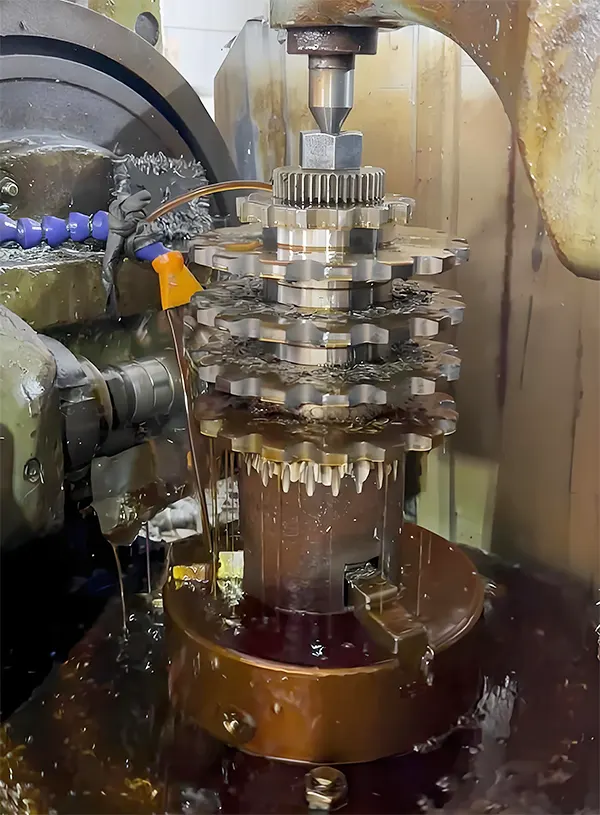
- Both ANSI and BS Standards Manufactured In-House: We manufacture both ANSI and BS/ISO roller chain sprockets on the same production line, with the same CNC tooling and quality system. We do not source one standard from a third-party manufacturer — both are manufactured under our direct quality control, with matching documentation.
- Standard Cross-Reference Expertise: Our engineering team has catalogued the chain and sprocket standards used on over 200 specialty harvester models across American, European, and Australian-assembled machines. When you give us a model number, we can typically confirm the correct standard from our reference database without requiring you to measure or photograph the existing components.
- Custom Manufacturing from Sample: For specialty harvester positions with proprietary tooth profiles or non-standard pitch dimensions, we manufacture from worn samples. We have matched sprockets for Italian and Spanish specialty harvester brands that were not catalogued by any Australian distributor.
- Food-Safe Certified Supply: All our stainless steel sprockets are supplied with material test certificates confirming the 304 or 316 grade. NSF H1 lubricant compliance documentation is available on request for HACCP system records.
Customer Cases
A Barossa Valley vineyard running a New Holland Braud VX7 and a Gregoire G75 had been unable to source matching BS 10B collection belt sprockets locally. After contacting us with photographs of the worn sprockets and chain side plates, we confirmed the correct BS 10B specification and supplied stainless steel sprockets for the must-contact positions within two weeks. “Finding a supplier who actually understands the BS versus ANSI issue — and has both standards available from their own factory — was the solution we had been looking for. Every other supplier we contacted just sent ANSI parts and said they were close enough.” ⭐⭐⭐⭐⭐
A Riverland almond operation running an Oxbo 9610 nut harvester sources all drive sprockets from us in ANSI standard. “You had every ANSI tooth count we needed across the whole Oxbo drive system — from the small row-unit sprockets to the elevator drive. One supplier, one shipment, everything matched. That is not the experience we have had trying to source these from local agricultural distributors.” ⭐⭐⭐⭐⭐
A Bundaberg macadamia processing operation running Australian-assembled Savage Equipment harvesters sources our ANSI 60 and ANSI 80 pickup and conveyor sprockets. “The sprocket quality is excellent — better tooth profile accuracy than the OEM parts we were using, and the hot-dip galvanised finish handles the Queensland humidity storage conditions perfectly. Your price is 38% below what the Savage dealer quoted for OEM.” ⭐⭐⭐⭐⭐
A Champagne region dealer supplying replacement parts for Pellenc and Gregoire harvesters in the French wine regions sources our full BS/ISO sprocket range for both brands. “Your ISO/BS range covers every Pellenc and Gregoire drive position we encounter. The stainless steel food-contact sprockets with NSF H1 documentation are essential for our premium winery customers who have strict HACCP documentation requirements.” ⭐⭐⭐⭐⭐
An Italian parts distributor supplying replacement sprockets for specialty harvesters across Northern Italy and southern France uses our full BS/ISO and ANSI range. “Your ability to match non-catalogue sprockets from worn samples has solved a persistent problem for us with older Italian and Spanish harvester models. In three cases this year you have matched sprockets that none of our other suppliers could identify.” ⭐⭐⭐⭐⭐
Complete Your Specialty Harvester Drive System
S-type, CA-type, and ANSI roller chains — manufactured to the same standards as our sprockets, supplied as matched sets.
Explore Chains →
⚡ PTO Shafts & Drivelines
T-series and wide-angle CV drivelines that deliver tractor PTO power to the chain-and-sprocket drives of every implement we serve.
Explore Drivelines →
⚙️ Agricultural Gearboxes
Right-angle bevel and parallel-shaft gearboxes forming the upstream reduction stages that feed implement chain drives.
Explore Gearboxes →
❓ Frequently Asked Questions
Find the Correct Sprocket for Your Specialty Harvester
Our engineering team specialises in ANSI and BS standard cross-matching for grape harvesters, nut harvesters, and specialty crop machines. Send us your machine make, model, year, and a photograph of the worn sprocket — we will confirm the specification and supply with full material documentation. Express delivery to Australia available for urgent harvest requirements.