Rantai Pertanian untuk Otomatisasi Pembibitan dan Rumah Kaca Cerdas
Automated nursery and greenhouse systems — seedling tray circulation systems, hanging basket conveyors, automated irrigation rigs, and transplant line drives — use chain drives that operate under fundamentally different requirements from field agricultural machinery. The emphasis is on step-precision (accurate positioning of trays at planting stations, sprinkler zones, and transplant robots), low vibration (which damages young seedling roots during transport), and food-safe cleanliness (the conveyor is part of a food-production facility).
Australia’s commercial nursery and greenhouse sector — hothouse tomato, cucumber, and capsicum production in Victoria and Queensland; seedling production for broadacre revegetation and forestry — is increasingly automated. The chain drives in these facilities must maintain precise step accuracy across millions of positioning cycles per growing season.
The Australian Operating Challenge
Automated transplant robots, sorting stations, and drip irrigation placement systems trigger on the physical position of the tray carrier on the conveyor chain. Position errors caused by chain elongation trigger missed placements, off-centre watering, and transplant failures that destroy the value of the growing cycle. Precision-pitch chain with maximum 0.8% elongation threshold is the engineering requirement for automated trigger positions.
Greenhouse chain drives operate in relative humidities of 80–100% continuously. Standard mineral oil lubricant emulsifies and washes off chain joints under high-humidity conditions, leaving joints dry between services. Food-grade synthetic lubricant with water-resistant additives or self-lubricating chain is appropriate for greenhouse chain positions.
Seedling roots are extremely sensitive to vibration during the early transplant phase. Chain conveyors with significant polygonal chordal action — caused by worn chains on worn sprockets — generate vibration at frequencies that have been shown to damage root establishment in sensitive seedling species. Precision low-noise chain with close pitch tolerance minimises chordal vibration.
Chain Specification Reference
| Position | Chain Standard | Precision Grade | Lubrication | Elongation Threshold |
|---|---|---|---|---|
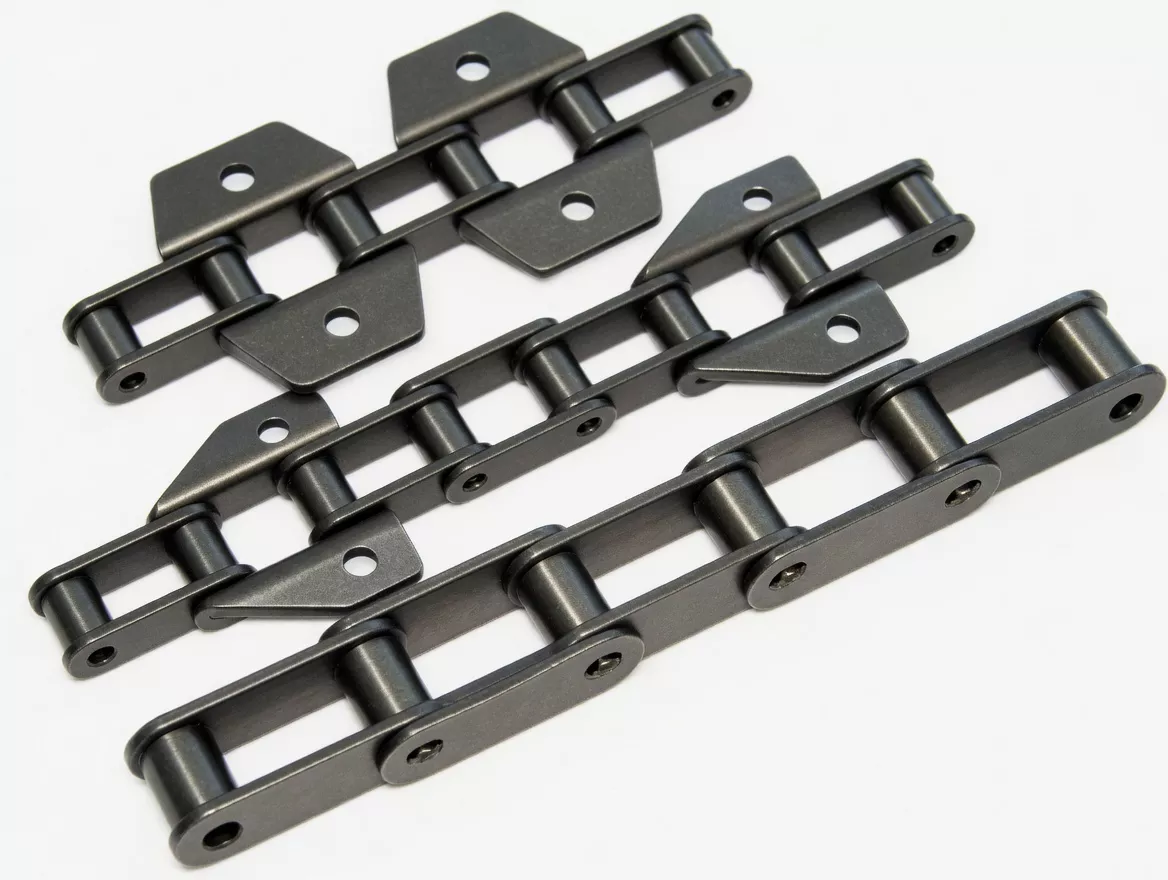
| Tray circulation (automated trigger zones) | Precision ANSI 40 or ANSI 50 | Precision tolerance | NSF H1 food-grade synthetic | 0.8% elongation |
| Hanging basket conveyor | ANSI 50 or ANSI 60 sealed | Standard | NSF H1 food-grade | 1.5% elongation |
| Irrigation rig traversal | ANSI 40 or ANSI 50 | Standard | Waterproof synthetic grease | 1.5% elongation |
| Transplant line main conveyor | Precision ANSI 40 or ANSI 50 | Precision | NSF H1 food-grade | 0.8–1.0% elongation |

❓ Frequently Asked Questions
Explore Related Drive Components
T-series, wide-angle CV and overrun-clutch protected drivelines that deliver tractor power into the chain drives of every implement.
Explore Drivelines →
⚙️ Agricultural Sprockets
Complete sprocket range including S-type, CA-type and ANSI roller chain sprockets to pair with every chain in this catalogue.
Explore Sprockets →
Enquire about matched chain-and-sprocket kits
We supply chain and sprockets together as matched sets — same standard, same quality grade, ready for immediate installation.