Жеміс-көкөніс орау желілеріне арналған ауылшаруашылық тізбектері
Fruit and vegetable packing lines in Australian horticulture — apple sorting facilities in the Yarra Valley, stonefruit packing sheds in the Goulburn Valley, and vegetable grading lines in the Swan Coastal Plain — share a common chain drive requirement that differs substantially from broadacre agricultural machinery: the emphasis is on low noise, gentle produce handling, and the precision running that automated optical sorting and weighing systems demand.
A produce packing line running at 20 sorter operations per minute must deliver absolutely steady chain speed through the full shift. Any speed variation introduced by worn rollers, tight links, or pitch errors shows up as sorting errors, weighing inaccuracy, and optical scanner mis-reads. Chain specification in this application is as much about dimensional stability and smooth running as it is about load capacity.
The Australian Operating Challenge
Automated sorting systems — by weight, colour, or size — require chain conveyor speed to be constant within very tight tolerances. A chain worn to 1.0% elongation introduces a speed variation as the elongated chain engages worn sprocket teeth that is sufficient to mis-trigger weighing cells and optical sorters. Shorter replacement intervals and precision pitch-tolerance chain are the specification response.
Packing shed staff work in close proximity to conveyors throughout full shifts. Noisy chains — caused by worn rollers impacting sprocket teeth, or by poor roller-tooth geometric fit from standard-tolerance chain — create unnecessary workplace noise. Low-noise roller chain with precision tooth-to-roller contact geometry significantly reduces operating sound levels.
Fruit and vegetable packing chains must not contaminate produce with lubricant. NSF H1 food-grade lubricant is required for all chains in direct produce contact zones. For premium produce lines supplying supermarket quality systems, full documentation of food-safe lubricant specification may be required for HACCP compliance.
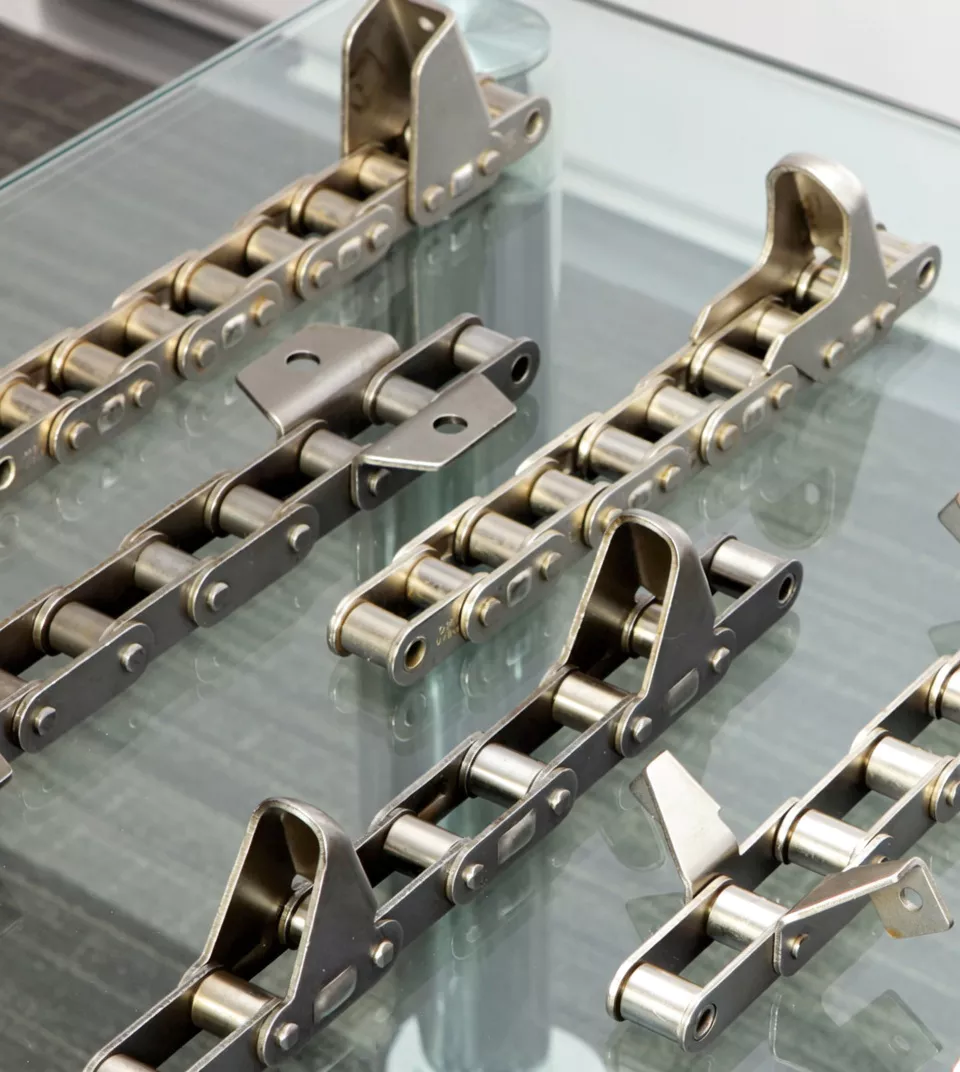
Chain Specification Reference
| Position | Chain Type | Lubrication | Noise Level | Replacement Threshold |
|---|---|---|---|---|
| Main grading conveyor | Precision ANSI 40 or ANSI 50 | NSF H1 food-grade | Low — precision roller contact | 1.0% elongation for automated sorter accuracy |
| Transfer conveyors | ANSI 50 or ANSI 60 standard | NSF H1 | Standard | 1.5% elongation |
| Vertical elevator to bin | CA-type with cup attachments | NSF H1 or dry-film | Standard | 1.5% elongation |
| Drive and tensioner | ANSI 60 double-strand | NSF H1 | Standard | 1.5% elongation |

❓ Frequently Asked Questions
Explore Related Drive Components
Matched sprockets for every chain type we supply — plate wheel, taper-bore and hardened-tooth profiles manufactured to the same ISO standards.
Explore Sprockets →
️ Agricultural Gearboxes
Right-angle bevel and parallel-shaft gearboxes for PTO-driven implements — the upstream drive partner to every chain transmission.
Explore Gearboxes →
Request OEM-pattern or replacement chain
Supply us with a part number, worn sample, or machine serial number. Our engineers will match it to the correct chain specification.