Precision-Ground, Corrosion-Resistant Sprockets for Australian Air Seeder Drive Systems
The air seeder is the most precision-sensitive machine in Australian broadacre farming. Every hectare planted depends on the mechanical accuracy of the seed metering and fertiliser metering drive chains — and those drives are only as accurate as the sprockets that transmit motion to them. A sprocket with even marginal tooth wear introduces a cyclic speed variation into the metering drive that translates directly into seeding rate error across the paddock. On a 6,000-hectare planting program, a 2% rate deviation from worn metering sprockets means the difference between target establishment and a visible population problem at emergence.
Beyond precision, air seeders face a corrosion challenge that virtually no other broadacre machine encounters: the metering system handles granular fertiliser — urea, MAP, DAP, and potash blends — that is hygroscopic, acidic, or oxidising in nature. Standard carbon steel sprockets in direct fertiliser contact corrode measurably within a single planting season. We engineer our air seeder sprockets specifically for this dual requirement: dimensional precision for metering accuracy, and aggressive corrosion resistance for fertiliser exposure.
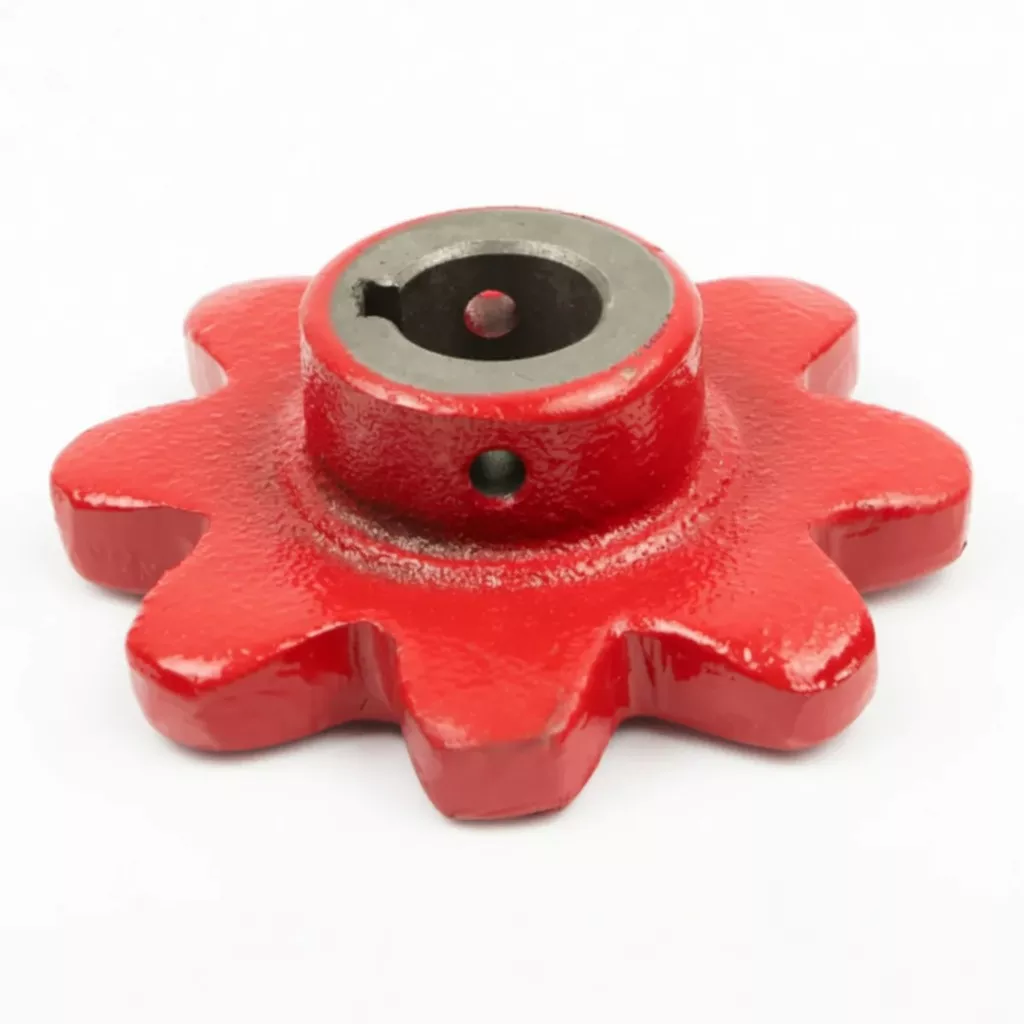
⚙️ Air Seeder Drive Positions and Their Sprocket Requirements
An air seeder runs multiple independent chain drives from a single ground wheel or hydraulic motor input. Each drive position has distinct precision and chemical exposure requirements that demand a matched sprocket specification.
The primary precision position. Ground wheel motion is transmitted through a chain-and-sprocket ratio to the seed metering rolls, setting the exact seed delivery rate per revolution of travel. Any tooth wear in this drive changes the effective transmission ratio, shifting the actual seeding rate away from the calibrated target. Sprockets must hold pitch accuracy to within ±0.5% across the full service life. Smooth hardened tooth flanks with correct ISO tooth form are essential.
Operates in or adjacent to granular fertiliser — urea, MAP/DAP, potash — that is both abrasive and corrosive. Phosphate-coated carbon steel or stainless steel sprockets are the appropriate specification for positions with direct fertiliser contact. Standard bare carbon steel corrodes visibly within 6–12 months of continuous fertiliser exposure.
Transmit the full ground wheel drive torque to the seeder jackshaft. These run at higher load than the metering drives and require sufficient tooth strength to handle the shock loads encountered when the seeder transitions between soil types or crosses irrigation bays. Case-hardened or through-hardened specification appropriate.
Drive the pneumatic conveying fan and any secondary distribution systems. These positions see moderate sustained load with moderate abrasive dust exposure from the airstream. Standard case-hardened sprockets are appropriate for these positions with correct chain tensioning maintained.
A seed metering drive sprocket worn by just 0.8% of tooth flank material creates a pitch variation of approximately 0.4–0.8% per tooth engagement. On a 36-row air seeder delivering wheat at 100 kg/ha, this translates to a rate variation of 0.8–1.6 kg/ha across the width of the machine — creating visible inter-row population variation at emergence in high-yielding varieties sown to target populations.
Australia-Specific Challenges: Fertiliser Chemistry and Sandy Soil Abrasion
Australian air seeder operations impose two distinct failure modes on sprockets that European manufacturers rarely engineer for at the same intensity:
Australian broadacre operations are among the world’s most fertiliser-intensive per hectare of dryland grain production. Urea application rates of 80–150 kg/ha combined with single or double superphosphate and potash blends means the metering system handles corrosive chemistry continuously throughout the planting window. Potassium chloride (MOP potash) is particularly aggressive — the chloride ion concentration attacks bare steel through pitting corrosion at a rate that makes standard carbon steel sprockets unsuitable for direct potash contact positions.
Air seeders operating in WA Wheatbelt red sandy loams, the NSW Mallee, and South Australia’s cereal belt work in fine silica dust conditions throughout planting. This dust enters metering housings and settles on all exposed sprocket surfaces. In the metering drive, fine silica trapped between roller and tooth acts as a cutting compound that removes tooth material in the same abrasive mechanism seen in combine harvester feeder house sprockets — but at the precision tolerances demanded by metering drives.
Planting season in southern Australia involves large daily temperature ranges — from cool mornings in the 8–12°C range to afternoon highs of 28–36°C. This thermal cycling causes differential expansion between the steel sprocket and the shaft, creating micro-fretting at the bore contact. Correctly specified keyway fits and appropriate bore tolerances are essential to prevent bore fretting in wide-cycling temperature environments.
Air Seeder Sprocket Specifications
| Position | Chain Standard | Typical Teeth | Bore / Hub | Material / Treatment | Surface Finish |
|---|---|---|---|---|---|
| Seed metering drive | ANSI 40 or ANSI 50 | 8–32T | Finished bore with keyway | Medium carbon steel, case hardened HRC 45–52 | Ground tooth flanks — precision grade |
| Fertiliser metering (direct contact) | ANSI 40 or ANSI 50 | 8–32T | Finished bore with keyway | 304 SS or phosphate-treated carbon steel | Smooth for easy cleandown |
| Ground drive jackshaft | ANSI 60 / ANSI 80 | 12–60T | Pilot bore or taper-lock | Case hardened carbon steel HRC 45–52 | Standard machined |
| Fan / pneumatic drive | ANSI 60 double-strand | 16–36T | Finished bore, keyway | Case hardened carbon steel | Standard machined |
| Rate change gearbox output | ANSI 40 or ANSI 50 | Various (variable ratio) | Pilot bore for machining | Case hardened or through-hardened | Precision ground tooth |
️ Corrosion Resistance Options — Matching Your Fertiliser Chemistry
We offer three corrosion resistance tiers for air seeder sprockets, each matched to a specific fertiliser chemistry exposure level:
| Treatment | Suitable For | Corrosion Resistance | Service Life vs Bare Steel | When to Specify |
|---|---|---|---|---|
| Phosphate coating | Urea, DAP, MAP | Good — moderate fertiliser chemistry | 2–3× longer | Standard planting operations with urea-dominant blends |
| Zinc-nickel electroplating | Urea, DAP, MAP, potash blends | Excellent — including chloride resistance | 4–6× longer | Mixed blends including MOP potash |
| 304 Stainless Steel | All fertiliser types including potash | Outstanding — multi-season resistance | 8–12× longer | Continuous potash contact, high-throughput operations |
How to Select the Right Air Seeder Sprocket
Seed metering positions that are fully enclosed and separated from the fertiliser flow can use standard case-hardened carbon steel. Any sprocket position adjacent to the fertiliser metering rolls, or inside the fertiliser hopper outlet zone, requires at minimum phosphate-coated specification. For potash-containing blends, specify zinc-nickel or stainless.
The tooth count determines the metering drive ratio and therefore the delivered seeding rate. Do not assume — count teeth on the worn sprocket directly or look up the exact count in the manufacturer’s parts manual. Even one tooth difference in a metering drive sprocket changes the seeding rate by several percent.
Most air seeders have multiple sprocket positions used to change seeding rate by swapping sprocket combinations. Ensure you have the full set of sprockets used across your intended rate range, not just the single combination currently fitted. We supply full rate-change sprocket sets for all major Australian air seeder brands.
Operations that change between seed types or fertiliser blends mid-season require sprockets with smooth surfaces that shed product during high-pressure wash-down. Stainless or zinc-nickel plated sprockets with smooth tooth surface finish are easier to clean thoroughly and reduce cross-contamination between products.
Our Manufacturing Advantage for Precision Agricultural Sprockets
We have manufactured precision agricultural sprockets since 2003, supplying to dealerships and farming operations across Australia, New Zealand, North America, and Europe. Our facility operates 40+ CNC machining centres dedicated exclusively to agricultural drive components, with a dedicated R&D team of 18 engineers specialising in agricultural transmission engineering. For air seeder metering sprockets specifically, we maintain:
- Pitch Tolerance Control: Our metering sprockets are manufactured to a pitch tolerance of ±0.3% — tighter than the ISO 606 standard requires — to ensure the rate accuracy that Australian precision agronomy demands.
- Tooth Profile Verification: Every batch of metering sprockets is profile-checked on a CMM (coordinate measuring machine) against the master tooth form. Profiles outside tolerance are rejected before leaving the factory.
- Material Certification: Every order is accompanied by a material test certificate, hardness test report, and dimensional inspection record. For stainless sprockets, the material certificate confirms the austenitic grade and chromium/nickel content.
- OEM Pattern Matching: We match John Deere, Bourgault, Horsch, Morris, and all major air seeder brands’ sprocket specifications from OEM part numbers, worn samples, or machine serial numbers.
Customer Cases — Air Seeder Operators Who Switched to Our Sprockets
A 4,500-hectare wheat/canola operation on the Eyre Peninsula had been experiencing metering rate inconsistency mid-season, diagnosed as tooth wear on their ANSI 50 seed metering sprockets after 300 planting hours. After switching to our zinc-nickel plated precision-ground sprockets, they completed a full planting season with no measurable rate drift and zero sprocket replacements. “The rate consistency from first paddock to last was the best we have seen in eight seasons of planting on this farm.” ⭐⭐⭐⭐⭐
A planting contractor running three Bourgault air seeders was replacing metering sprockets twice per season in the abrasive red sand conditions of the WA Wheatbelt. Our phosphate-treated case-hardened sprockets extended service life to a full season with no mid-season replacement. “Your sprockets handled a full Wheatbelt season without any measurable tooth wear on the metering drive. The phosphate coating made a real difference — no rust between the spring planting and the following autumn inspection.” ⭐⭐⭐⭐⭐
A large Manitoba grain farm running Morris and John Deere air drills replaced all metering sprockets with our stainless specification after persistent corrosion failures in potash-blended fertiliser metering positions. “We tried phosphate-coated and they still showed pitting after one season of potash contact. Your 304 SS sprockets have now run three full seasons with no surface degradation — the cleandown between crops is also much faster with the smooth stainless surface.” ⭐⭐⭐⭐⭐
An agricultural contractor running six Pöttinger Aerosem and Horsch Avatar air seeders across the pampas sourced our full metering sprocket sets. “Your rate-change sprocket sets are complete — every combination we use for wheat, soy, and maize is covered in one order. The precision is evident immediately on calibration: we hit target rates on the first pass without correction adjustments.” ⭐⭐⭐⭐⭐
A 12-farm cooperative applying variable-rate seeding programs with GPS-linked Horsch Pronto air seeders uses our precision-ground metering sprockets across all machines. “Your CMM inspection certificates give our precision agronomy program the sprocket traceability we require. When our agronomy consultant audits our seeding accuracy, the sprocket specification is part of the documentation chain — your paperwork makes that straightforward.” ⭐⭐⭐⭐⭐
Complete Your Air Seeder Drive System
S-type, CA-type, and ANSI roller chains matched to every sprocket in our range — same standards, same quality grade, same manufacturer.
Explore Chains →
⚡ PTO Shafts & Drivelines
Wide-angle CV and T-series drivelines connecting tractor PTO to every implement chain drive we serve.
Explore Drivelines →
⚙️ Agricultural Gearboxes
Right-angle and parallel-shaft gearboxes forming the upstream reduction stage for PTO-driven chain-and-sprocket implement drives.
Explore Gearboxes →
❓ Frequently Asked Questions
Tell Us Your Sprocket Specification
Our engineering team responds within 24 hours. Send us an OEM part number, a worn sprocket sample, or your machine’s make and model — we will confirm the correct specification, provide full material documentation, and deliver at 30–50% below OEM price.