ð Agricultural Chains for Grape Harvesters: Food-Safe and Self-Lubricating Drive Solutions for Australian Viticulture
Grape harvesters present an agricultural chain specification challenge that is unique in Australian viticulture: the chain drives operate in direct proximity to the harvested grape must â juice, skins, and pulp that is destined for winemaking or fresh juice production. Any lubricant contamination of the must from conventional chain drives represents both a food safety breach and a potential winemaking fault. The chain drives on a grape harvester must therefore use food-grade or self-lubricating chain â and must maintain reliable mechanical performance for the entire harvest run without conventional lubrication.
This guide covers the chain specification requirements for grape harvester shaker drives, collection belt conveyor chains, and bucket conveyor systems in Australian wine and table grape operations.
âï¸ Where Agricultural Chains Are Used on This Machine
The main power transmission chain driving the working components. Requires heavy-duty specification matched to the peak torque of the application.
Moves material through the machine. Must resist abrasion from crop material and environmental contamination while maintaining dimensional accuracy.
Sub-drives for auxiliary systems. Light to medium duty but must be dimensionally compatible with the primary drive timing where applicable.
ð¦ðº The Unique Chain Engineering Challenge in Australian Viticulture
The collecting belt and bucket conveyor chains on a grape harvester operate immediately adjacent to grape must throughout the harvest. Conventional mineral oil chain lubricant is a food safety contaminant â it is detectable by winery receiving tests and can cause off-flavours in wine. Food-grade or self-lubricating chain is the only appropriate specification for any chain position where lubricant contact with the must is possible.
The shaker drives on straddler-type grape harvesters subject the drive chains to vibration frequencies of 6â15 Hz for hours at a stretch. This high-frequency cyclic loading creates a fatigue environment fundamentally different from the shock-load profile of balers or floor chain startup. Self-lubricating chains with polymer-impregnated sintered bushings resist the fretting wear at bushing-pin surfaces that standard chains experience under high-frequency vibration.
Grape must is mildly acidic (pH 3.2â3.8 for most varieties) and contains sugars that promote microbial growth on chain surfaces. Chains left with grape juice residue on joint surfaces corrode more rapidly than those cleaned after each use. Specifying stainless steel for chains in direct must-contact positions eliminates the corrosion-under-contamination failure mode.
ð Chain Specifications for grape harvesters
| Position | Chain Specification | Lubrication Type | Food Safe Rating | Key Property |
|---|---|---|---|---|
| Shaker drive (canopy contact) | ANSI 40 or ANSI 50 self-lubricating | Polymer-bushed, oil-free | NSF H1 / food-grade spec | Fretting wear resistance under high-frequency vibration |
| Collection belt conveyor | 304 SS roller chain or NSF H1 food-grade | NSF H1 or dry-film | Yes â direct must contact risk | Corrosion resistance, easy clean |
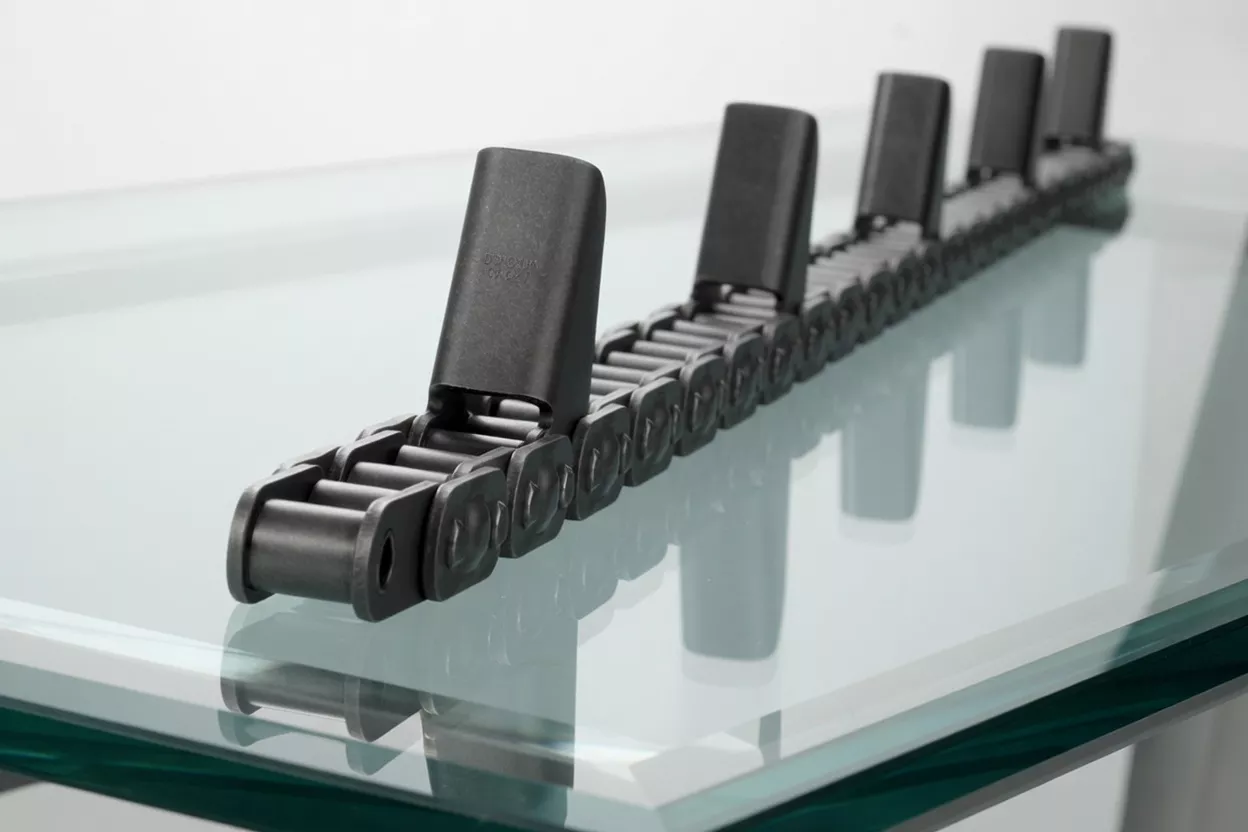
| Bucket elevator | 304 SS CA-type or attachment chain | NSF H1 lubricated or dry | Yes | Acid resistance, smooth bucket release |
| Transfer conveyor to bin | ANSI 60 with NSF lubricant | NSF H1 food-grade lubricant | Preferred | Standard duty â maintain lubrication with food-grade oil |
Selecting the Right Chain
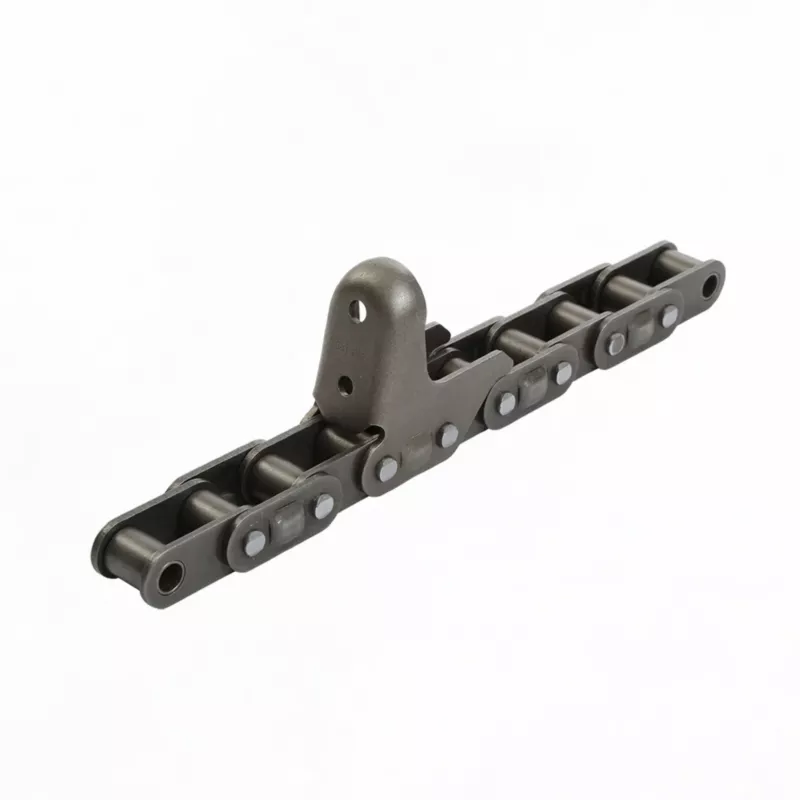
Any chain within splash or drip distance of the grape must collection zone must use NSF H1 rated food-grade lubricant or be specified as self-lubricating (polymer-bushed, oil-free). For the collection belt and bucket elevator positions, stainless steel self-lubricating chain eliminates both the lubrication management complexity and the corrosion risk simultaneously.
Standard chain with mineral oil lubricant experiences fretting wear at the bushing-pin contact under the high-frequency vibration of shaker drives — the oscillation repeatedly breaks the oil film and allows metal-to-metal contact. Self-lubricating chains with polymer-impregnated sintered bushings maintain a consistent lubricant film under vibration and do not require re-lubrication during the harvest campaign.
Grape harvester chains in must-contact positions must be cleaned with food-compatible detergent after each harvest day to prevent sugar-based microbial growth on chain surfaces. Avoid high-pressure water on self-lubricating chains as it can flush the polymer lubricant reservoir — use low-pressure rinsing.
Some wineries operating to premium quality protocols require documentation of all materials in contact with the must stream, including chain specification. Ensure chain supply documentation includes material grade, lubricant specification, and food safety rating for inclusion in winery HACCP documentation if required.
Maintenance Practices
Grape harvester chain maintenance is constrained by food safety requirements and the high-vibration operating environment of the shaker system.
Rinse must-contact chains with food-safe cleaning solution at low pressure. Inspect for bent attachment links on collection and bucket chains. Re-lubricate food-grade zones with NSF H1 lubricant where required.
Measure shaker drive chain elongation. Replace self-lubricating chains at 1.5% elongation — the polymer bushing becomes less effective as pitch increases. Inspect 304 SS collection chains for any signs of stress cracking in bent links from vineyard contact.
Replace self-lubricating shaker drive chains proactively if the machine completed more than 400 harvesting hours in the previous season. Full must-contact chain replacement is a prudent annual maintenance practice to ensure food safety compliance.
❓ Frequently Asked Questions
Explore Related Drive Components
T-series, wide-angle CV and overrun-clutch protected drivelines that deliver tractor power into the chain drives of every implement.
Explore Drivelines →
⚙️ Agricultural Sprockets
Complete sprocket range including S-type, CA-type and ANSI roller chain sprockets to pair with every chain in this catalogue.
Explore Sprockets →
Request OEM-pattern or replacement chain
Supply us with a part number, worn sample, or machine serial number. Our engineers will match it to the correct chain specification.