Corrosion-Resistant, Easy-Replace Sprockets for Grain Augers — Built for the Australian Outdoor Storage Reality
The grain auger is the most widely used grain-handling implement on Australian farms — from the portable swing-augers that move grain from field bins to trucks, to the fixed pit augers at on-farm storage facilities, to the large-diameter transfer augers connecting storage silos. What all these applications share is the same operating reality: the auger spends the vast majority of its life parked outdoors, exposed to rain, salt air, UV radiation, and seasonal temperature extremes, without the maintenance attention given to machinery that operates year-round.
This outdoor storage reality is the defining sprocket challenge for grain augers. The drive sprocket — typically an ANSI 60 or ANSI 80 single or double-strand configuration driving the auger flighting from a motor or PTO — sits exposed at the drive end of the tube for months between uses. Standard bare carbon steel sprockets rust visibly within one season. Rusted sprockets damage the chain at startup, run noisily, and lose tooth geometry through surface pitting — transforming a straightforward wear item into a premature replacement that costs the farmer more than the sprocket is worth.
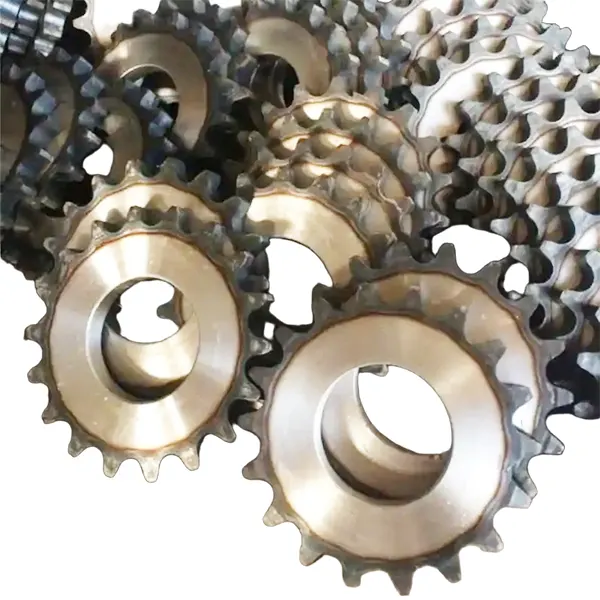
⚙️ Grain Auger Drive System Overview
The most common grain auger configuration in Australian broadacre farming. PTO or electric motor driven, 8–12-inch tube diameter, 8–15 metre reach. The drive sprocket sits at the base of the auger tube, typically unguarded or in a light sheet steel housing that provides no moisture exclusion. ANSI 60 or ANSI 80 single-strand, 13–17 teeth, finished bore or taper-lock, is the standard specification. The combination of outdoor exposure and infrequent use makes corrosion the primary failure mode.
Larger-diameter transfer augers feeding storage silos — 12–16-inch diameter, 20–40 metre length — use double-strand ANSI 80 or ANSI 100 for the main drive. These machines see more annual operating hours than portable swing-augers but are still subject to outdoor atmospheric exposure during the months between grain campaigns. The higher torque of large-diameter transfer augers demands correctly-rated sprocket specification — undersized sprockets fail under the starting torque of a full-length auger tube.
Electric motor-driven augers are increasingly common in permanent on-farm storage installations. The motor typically drives through an ANSI 60 or ANSI 80 chain and sprocket reduction to the auger input shaft. The motor-side sprocket and the auger-side sprocket must both be correctly rated for the motor’s stall torque — which can be 3–5× the running torque at startup. Electric motor drive sprockets must also be rated for the higher starting torque of direct-online motor starts.
The fill auger on grain storage systems — which fills storage bins from the delivery vehicle — uses similar sprocket specifications to the swing-auger but may need stainless steel or heavy galvanised specification where it is mounted in a permanently-wet environment near the bin base drainage zone.
Grain auger sprockets fail through a specific corrosion sequence. First, surface rust forms on the bare steel tooth flanks during outdoor storage — typically within 3–6 months in coastal grain regions, or within one wet season in humid grain-growing areas. The rust layer is slightly harder and more abrasive than the base metal. When the auger starts after a storage interval, the rusted tooth flanks abrade the chain rollers at startup, generating metal particles that enter the lubrication film and accelerate wear for the entire operating session. After several seasons of this cycle, tooth profile is lost through a combination of rust-and-abrasion that is faster than either mechanism acting alone.
Australian Grain Region Corrosion Profiles
The WA Wheatbelt’s coastal margin and the Yorke and Eyre Peninsulas in South Australia experience significant salt-air corrosion loading from onshore sea winds. Bare steel grain auger sprockets in these regions can develop surface rust within 2–3 months of outdoor storage. Hot-dip galvanised sprockets with minimum zinc coat weight of 85 g/m² are the recommended specification for these regions — they typically provide 4–6 years of outdoor storage protection with no maintenance treatment.
The northern grain belt of NSW — Darling Downs, Liverpool Plains — and southern Queensland storage facilities experience high summer humidity. Even without direct salt-air exposure, high humidity accelerates carbon steel corrosion to the point where annual maintenance treatment is required to protect bare steel sprockets through the storage season. Phosphate-coated or galvanised specification eliminates this maintenance requirement.
Southern Victorian and SA grain storage facilities experience near-freezing temperatures in the period between harvest and the first post-harvest auger use. Cold temperatures increase lubricant viscosity significantly, amplifying the startup torque demand. Sprockets and chains cold-started without pre-warm lubrication in these conditions experience higher peak loading than the same equipment in warm-climate storage.
Grain Auger Sprocket Specifications
| Auger Type | Chain Standard | Typical Sprocket | Material | Surface Treatment | Recommended For |
|---|---|---|---|---|---|
| Portable swing-auger (8–10 inch) | ANSI 60 single-strand | 13–17T, pilot bore or taper-lock | SAE 1045 carbon steel | Hot-dip galvanised or Zn-Ni | All Australian grain regions |
| Portable swing-auger (10–12 inch) | ANSI 80 single-strand | 12–17T, taper-lock preferred | SAE 1045 carbon steel | Hot-dip galvanised | Standard outdoor storage |
| Fixed transfer auger (12–16 inch) | ANSI 80 double-strand | 12–21T, taper-lock | SAE 1045 carbon steel | Hot-dip galvanised or Zn-Ni | High-torque fixed installations |
| Electric motor drive (auger-side) | ANSI 60 or ANSI 80 | As per ratio requirement | SAE 1045 carbon steel | Hot-dip galvanised | Permanent storage installation |
| Electric motor drive (motor-side) | ANSI 60 or ANSI 80 | Small sprocket, high tooth count | SAE 1045 carbon steel | Phosphate coat or galvanised | Indoor motor — standard spec acceptable |
| Bin fill auger (wet environment) | ANSI 60 single-strand | 13–17T | 304 Stainless Steel or hot-dip galv | 304 SS or galvanised | Near-drain or permanently-wet positions |
️ Why Hot-Dip Galvanising is the Right Specification for Australian Grain Auger Sprockets
Hot-dip galvanising — immersing the finished sprocket in molten zinc at 450°C — creates a zinc-iron alloy layer bonded metallurgically to the steel substrate. This is fundamentally different from zinc electroplating or phosphate coating in both the bond strength and the coating thickness achieved.
- Coating thickness 85–100 g/m²: Hot-dip galvanising achieves 3–5× the coating thickness of standard zinc electroplating, providing proportionally greater corrosion life in outdoor storage conditions.
- Sacrificial cathodic protection: Zinc is anodic to steel — in a corrosive environment, the zinc coating corrodes preferentially to the base steel, protecting the tooth flanks even where the coating is scratched or mechanically damaged during installation.
- No maintenance required during storage: Hot-dip galvanised sprockets can be stored outdoors through an entire Australian off-season without any maintenance treatment and emerge in serviceable condition. Standard or phosphate-coated sprockets require annual oil or grease treatment during outdoor storage to maintain acceptable corrosion protection.
- Cost-effective over a 5–10 year service life: The additional cost of hot-dip galvanising over standard carbon steel represents a fraction of the cost of one premature replacement driven by corrosion. For grain augers that may run only 100–200 hours per year, the galvanised specification typically pays back within the first replacement cycle avoided.
Supplying Australian Grain Farmers and Agricultural Dealers
We understand the economics of the Australian grain auger parts market. Farmers are pragmatic purchasers: they want a part that lasts, fits correctly, and is available when needed — at a price that does not require financial justification to the agronomist. Our grain auger sprocket range is designed around these priorities:
- No Minimum Order: Single sprockets for single-machine replacements are available with no minimum. Volume pricing applies at quantities of 10 and 50 pieces for dealerships stocking parts programs.
- Standard ANSI Sizes Always in Stock: ANSI 60 and ANSI 80 sprockets in the 13–21 tooth range are maintained in production stock. Lead time for standard sizes: same-week dispatch.
- Pilot-Bore Option for Non-Standard Shafts: Where the auger shaft is a non-standard diameter, pilot-bore sprockets can be finish-machined to your specification with a 1–2 week lead time.
- 30–50% Below OEM Auger Brand Pricing: Replacement sprockets for major Australian auger brands from our range are 30–50% below the price of the same brand’s OEM parts, with equivalent or better corrosion protection specification.
Customer Cases
An Eyre Peninsula grain farmer running three portable swing-augers and one fixed transfer auger had been replacing drive sprockets every two years due to salt-air corrosion damage during the long outdoor storage period. After switching to our hot-dip galvanised range, the same sprockets ran through four years of outdoor storage and three auger seasons without corrosion replacement. “The galvanised finish came out of four years of outdoor storage looking almost the same as when we installed it. We have never had that from any other sprocket we have used on these augers.” ⭐⭐⭐⭐⭐
A WA Wheatbelt parts distributor stocking replacement sprockets for portable auger brands transitioned to our hot-dip galvanised range as their primary stocking item. “Customers who buy your galvanised sprockets almost never come back to buy another one in the same season — the return rate on corrosion complaints dropped to zero after we switched from standard to galvanised. For a parts counter, that is the definition of a good product.” ⭐⭐⭐⭐⭐
A Nebraska grain operation running seven portable augers and two fixed transfer augers sources all drive sprockets from us in hot-dip galvanised finish. “The price point is right and the galvanised finish handles Nebraska winters in outdoor storage without any maintenance. We used to paint the drive ends of our augers every two years to protect the sprockets — that maintenance is completely gone now.” ⭐⭐⭐⭐⭐
An Argentine grain handling contractor running 14 portable augers across multiple harvest seasons in the humid Entre Ríos region sources our Zn-Ni plated sprockets for their most corrosion-exposed positions. “The zinc-nickel plating holds up through Entre Ríos summers far better than hot-dip galvanising alone. We have seen the galvanised sprockets develop white rust in one humid season here — the Zn-Ni sprockets show no surface change at the same interval.” ⭐⭐⭐⭐⭐
A South Island grain farm with seven portable augers sources our ANSI 60 hot-dip galvanised sprockets for all swing-auger applications. “The fitting and finish are the best we have seen from any aftermarket supplier. Every sprocket has fitted perfectly to the shaft and chain without any adjustment, which is not always the case with budget supply. The price versus OEM is 40% less and the quality is if anything better.” ⭐⭐⭐⭐⭐
Complete Your Grain Auger Drive System
S-type, CA-type, and ANSI roller chains — manufactured to the same standards as our sprockets, supplied as matched sets.
Explore Chains →
⚡ PTO Shafts & Drivelines
T-series and wide-angle CV drivelines that deliver tractor PTO power to the chain-and-sprocket drives of every implement we serve.
Explore Drivelines →
⚙️ Agricultural Gearboxes
Right-angle bevel and parallel-shaft gearboxes forming the upstream reduction stages that feed implement chain drives.
Explore Gearboxes →
❓ Frequently Asked Questions
Enquire About Our Grain Auger Sprocket Range
Standard ANSI 60 and ANSI 80 hot-dip galvanised grain auger sprockets are in production stock with same-week dispatch. For specific brand matching or non-standard bores, contact us with your auger make, model, and shaft dimensions. No minimum order. 30–50% below OEM pricing.