Self-Lubricating and Food-Safe Sprockets for Oyster Grading and Sorting Machines
Oyster grading machines in Australia’s premium oyster production regions — Coffin Bay in South Australia, the Clyde River and Georges Bay in New South Wales, and Barilla Bay in Tasmania — operate under a constraint that makes them one of the most technically demanding sprocket applications in Australian food production: the machine processes live shellfish product that cannot under any circumstances come into contact with conventional industrial lubricants. The sprocket drives inside an oyster grader must function reliably in the absence of any petroleum-based or synthetic lubricant at the chain-sprocket contact surfaces — because any lubricant residue on the machine washes directly onto the oysters passing through the grading drums.
This ‘dry-run or water-only’ specification defines the entire engineering approach to oyster grading machine sprockets. The solution is not a single material but a combination: 316 stainless steel for precision drive positions where dimensional accuracy and load capacity demand metallic construction, and sintered polymer-bushed or self-lubricating acetal sprockets for the lighter-duty drive and transport positions where the self-lubricating material itself provides the bearing film at the chain-sprocket interface without any external lubricant addition.
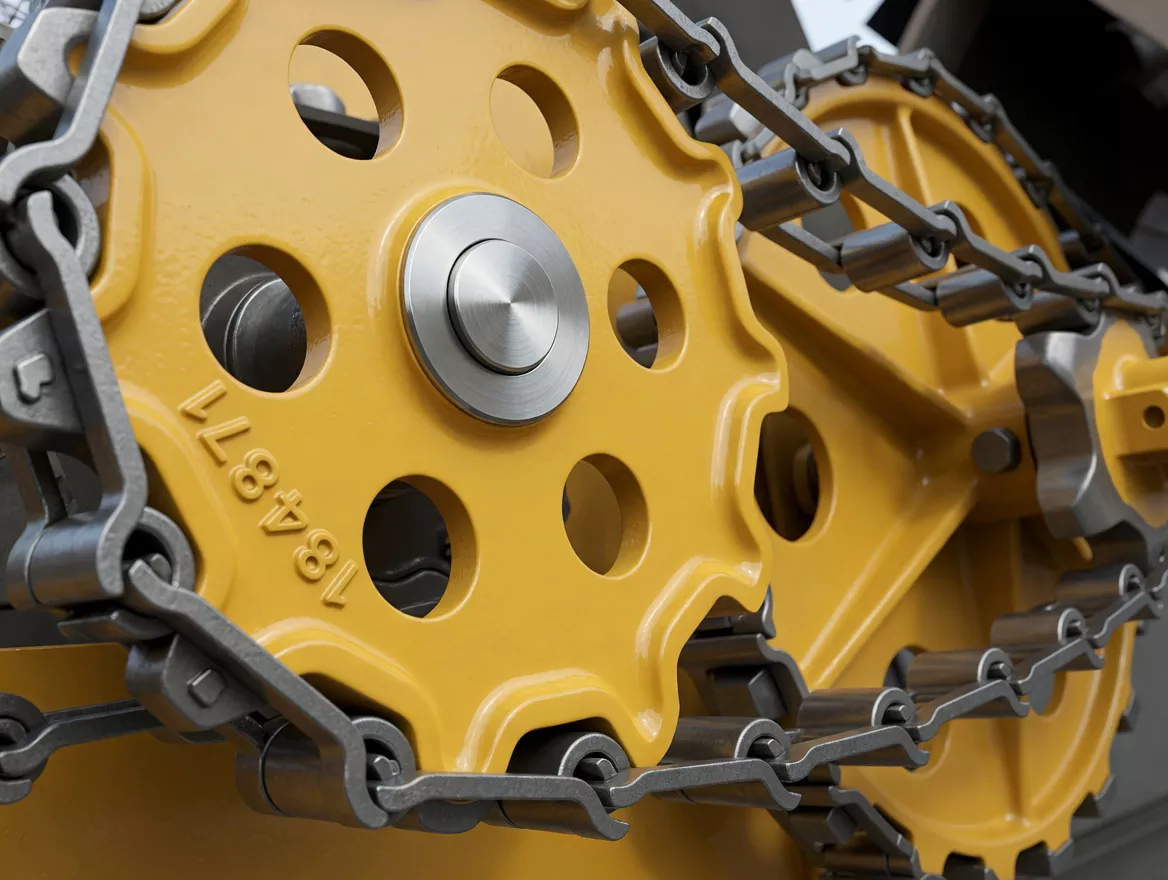
⚙️ The Oyster Grading Machine Drive System
Drive the rotating perforated drums that separate oysters by size. The drum drive sprockets run at low-to-moderate speed under continuous load — typically 20–60 RPM with the full weight of the oyster batch pressing against the drum wall. These positions require precise pitch accuracy to maintain consistent drum rotation speed, which directly affects grading accuracy. 316 SS with self-lubricating sintered bushing chain is the correct specification — metallic precision with zero lubricant addition.
Drive the rubber or plastic-belt conveyors that transport oysters between the receiving table, grading drums, and packing stations. These positions are continuously washed by the process water that lubricates and cleans oysters during grading. Any lubricant on these sprockets is immediately carried onto the oyster product stream. 316 SS or food-grade acetal (POM) sprockets running on self-lubricating chain is the appropriate specification.
Drive the wash water pumps and spray bar distribution systems. These positions see moderate torque with continuous water spray exposure. 316 SS is appropriate here — the wash water drive is not in direct product contact but is in the same hygiene zone as the grading system and must meet the same washdown resistance requirements.
Drive the final packing conveyors where graded oysters are collected and packaged. These are the lowest-load positions on the machine and the most distant from the wash water environment. Food-grade acetal (POM) or 316 SS depending on facility hygiene zone classification.
Live oysters are filter feeders — they continuously pump water through their gills and filter suspended particles from their environment. An oyster placed on a conveyor belt or grading drum that has been lubricated with even a trace of petroleum or synthetic oil will uptake that oil into its tissue through its natural feeding behaviour within minutes. The result is both a food safety violation (petroleum hydrocarbons in food product) and a product quality failure (off-flavours detectable by consumers). Australian oyster farmers selling to premium restaurant and export markets apply strict zero-tolerance standards to lubricant contamination. The correct engineering response is not to use food-grade lubricant sparingly — it is to design the drive system so that no external lubricant is required at all.
Self-Lubricating Materials for Oyster Grader Sprockets — How They Work
The chain used with 316 SS grader sprockets typically uses sintered bronze bushings impregnated with a food-grade solid lubricant (PTFE or graphite). As the chain articulates around the sprocket, the sintered bushing releases a micro-film of solid lubricant at the pin-bushing interface — this film provides the necessary bearing surface without any external lubricant addition. The system runs ‘dry’ from the operator’s perspective while maintaining a consistent internal lubricant reservoir in the bushing matrix. Service life in oyster grading conditions: 2,000–4,000 operating hours before bushing depletion.
Polyoxymethylene (POM/acetal) is a semi-crystalline engineering polymer with inherently low friction coefficient (0.1–0.15 against steel) and excellent wear resistance. Acetal sprockets running on stainless chain in the wet environment of an oyster grader benefit from the water film as a supplementary lubricant — the combination of acetal’s low intrinsic friction and the process water film produces running conditions comparable to lubricated steel-on-steel contact. Acetal is FDA-compliant and food-contact approved, dimensionally stable in the wet operating environment, and produces no metallic contamination risk.
In the continuously wet zones of an oyster grader — wash conveyors and drum drives — clean process water provides a hydrodynamic lubricant film at stainless chain-sprocket interfaces during operation. The water film reduces effective friction coefficient from 0.15–0.25 (dry steel-on-steel) to approximately 0.05–0.08 (water-lubricated steel-on-steel). This is sufficient for low-speed, low-contact-stress positions to operate indefinitely without external lubricant addition — provided the chain and sprocket materials are corrosion-resistant enough to tolerate the water exposure.
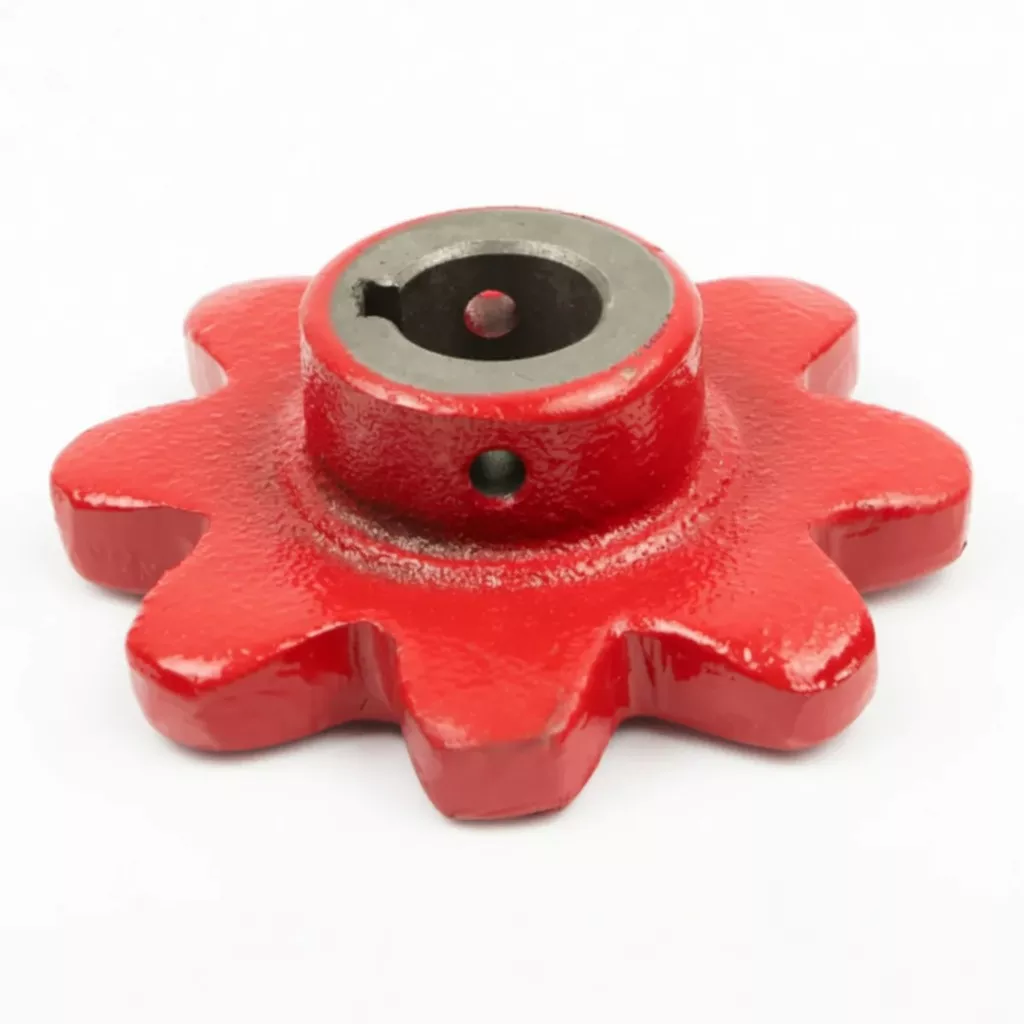
Oyster Grading Machine Sprocket Specification Reference
| Position | Chain Standard | Sprocket Material | Lubrication Method | Food Safety Rating | Washdown Resistance | Service Life |
|---|---|---|---|---|---|---|
| Grading drum drive | ANSI 40 or ANSI 50 self-lubricating SS chain | 316 Stainless Steel | Self-lubricating sintered chain bushing | 316 SS — FDA / FSANZ compliant surface | Full high-pressure washdown | 5–8 years |
| Product conveyor belt drive | ANSI 40 SS chain or ANSI 50 SS chain | 316 SS or Acetal (POM) | Water film + self-lubricating chain | Food-contact approved (both materials) | Full washdown | 316 SS: 5–8 yr; POM: 3–5 yr |
| Wash water pump drive | ANSI 50 or ANSI 60 SS chain | 316 Stainless Steel | Water film — fully wet zone | 316 SS compliant | Continuous water exposure | 5–8 years |
| Packing / transfer conveyor | ANSI 40 or ANSI 50 chain | Acetal (POM) or 316 SS | Water film / self-lubricating chain | Food-contact approved | Regular washdown | POM: 3–5 yr; SS: 5+ yr |
️ Washdown Protocol Compatibility
Australian oyster processing facilities operate under FSANZ and HACCP hygiene standards that require complete washdown of all product-contact surfaces after each production shift. Our oyster grader sprocket specifications are designed to survive this protocol without accelerated degradation:
- 316 SS sprockets: Fully compatible with high-pressure washdown at any pressure. Resistant to food-safe acid sanitisers (citric acid, peracetic acid) at normal processing concentrations. Avoid chlorine bleach at concentrations above 200 ppm directly on stainless — rinse promptly after any bleach contact.
- Acetal (POM) sprockets: Compatible with high-pressure washdown and all common food-safe sanitisers including peracetic acid, citric acid, and quaternary ammonium compounds. POM is resistant to dilute acids and alkalis in the concentration ranges used in shellfish processing. Avoid concentrated bleach (above 1,000 ppm available chlorine) on POM — extended contact causes surface oxidation and dimensional swelling.
- Self-lubricating sintered chain: Pressure-wash at low pressure (below 600 kPa) to avoid flushing the solid lubricant from the sintered bushing matrix. High-pressure direct washing of sintered bushings reduces the lubricant reservoir service life by 30–50%.
Customer Cases
A Coffin Bay Pacific oyster operation running a rotary drum grader specified our 316 SS drum drive sprockets with self-lubricating chain after contamination concerns with their previous lubricant-dependent system. “The self-lubricating chain and 316 SS sprocket combination runs 8-hour grading sessions without any lubricant addition whatsoever. No contamination events since commissioning, and the washdown is straightforward — no lubricant film to remove from the drum surfaces before the next session.” ⭐⭐⭐⭐⭐
A Clyde River wholesale oyster operation specified our POM acetal conveyor sprockets for their product transfer conveyors after finding that 304 SS equivalents showed surface rust within 6 months. “The acetal sprockets simply cannot corrode — that problem is gone completely. They have been running for 19 months in the full washdown environment with no dimensional change and no surface degradation visible. The water film is genuinely adequate lubrication at our conveyor speed.” ⭐⭐⭐⭐⭐
A premium Marennes-Oléron oyster producer specifies our 316 SS and acetal combination for their automated grading line. “Your material documentation — 316 SS mill certificates with molybdenum content, and POM food-contact compliance data sheet — is directly inserted into our HACCP plan. The traceability your documentation provides satisfies our Label Rouge quality auditor requirements without any additional supplier qualification testing.” ⭐⭐⭐⭐⭐
A Galway Bay oyster operation specifies our full 316 SS sprocket range for their grading machine. “Atlantic seawater is highly saline and the Galway Bay environment is particularly demanding. Your 316 SS specification with the molybdenum content confirmed on the mill certificate is the only material we have found that provides multi-year service without pitting in our conditions.” ⭐⭐⭐⭐⭐
A Hiroshima oyster processing facility running high-volume automated grading specifies our 316 SS drum drive sprockets with self-lubricating chain. “Japanese food safety inspection standards are extremely strict regarding lubricant contamination of shellfish product. Your self-lubricating chain and 316 SS sprocket system is the only configuration we have approved for use in our direct product-contact drive positions — the zero external lubricant requirement is non-negotiable.” ⭐⭐⭐⭐⭐
Complete Your Shellfish Processing Drive System
S-type, CA-type, and ANSI roller chains matched to every sprocket in our range — same standards, same quality, same manufacturer.
Explore Chains →
⚡ PTO Shafts & Drivelines
T-series and wide-angle CV drivelines that deliver tractor PTO power into every implement chain drive we serve.
Explore Drivelines →
⚙️ Agricultural Gearboxes
Right-angle bevel and parallel-shaft gearboxes forming the upstream drive stage for every PTO-powered chain system.
Explore Gearboxes →
❓ Frequently Asked Questions
Specify Food-Safe Sprockets for Your Oyster Grader
Tell us your grading machine make, model, and which positions require zero-lubricant specification — we will confirm 316 SS vs acetal vs self-lubricating chain for each drive position and supply with complete HACCP-ready material documentation. 30–50% below OEM pricing.