Agricultural Chains for Cotton Pickers: Precision Drive Solutions for Australia’s Cotton Belt
Cotton pickers rank among the most capital-intensive harvesting machines in Australian agriculture. A single machine represents several hundred thousand dollars of investment, and its operational window is compressed into weeks of peak-quality harvest in Queensland and New South Wales. In this context, chain drive reliability is not a maintenance discussion — it is a production continuity imperative. Every chain on a cotton picker must perform to OEM tolerance, maintain dimensional stability under load, and synchronise precisely with adjacent drives to prevent wrap failures, bale formation errors, and picking-head damage.
This guide covers the chain specification requirements for cotton picker drives — including picking head systems, internal inline baling chains, and conveyor transfer positions — with specific reference to the operating conditions and machine reliability standards demanded by Australian cotton operations.
Why Chain Precision Matters More in Cotton Pickers Than Most Machines
Cotton pickers impose a precision requirement on their chain drives that few agricultural machines match. The picking heads on a spindle-type picker rotate at high speed with very tight clearances between spindles and doffing pads. Any angular phase error introduced by chain elongation or tension variation in the drive chain causes spindle-to-doffing contact outside the designed tolerance — leading to fibre wrap on drive shafts, picking head damage, and costly downtime. On brush-roll picker types, the brush assembly drives must maintain precise synchronisation across the full width of the machine to ensure even picking pressure and uniform fibre quality.
Unlike a feeder house chain that simply moves mass from A to B, the picking head drive chains on a cotton picker are precision timing elements. Chain elongation of as little as 0.8–1.0% in a multi-stage picking head drive chain can shift the phase relationship between spindle rows enough to cause picking anomalies and mechanically-induced fibre quality defects. This is why matching OEM chain standards exactly — not substituting with dimensionally similar alternatives — is critical.
⚙️ Key Chain Drive Positions on a Cotton Picker
Multi-stage roller chain drives connecting the main PTO input to the individual spindle row drives. These are precision timing chains — typically ANSI 40 or ANSI 50 double-strand — that must maintain phase accuracy across the full picking head assembly. Any elongation beyond 1.0% affects synchronisation quality.
Modern pickers with integrated inline balers (basket or module systems) use heavy roller chain to drive the bale formation chamber and compression system. These see high shock loads during bale compression and must be rated for the full bale-formation torque without elongating under load.
Move harvested cotton from the picking heads through the air conveying system into the basket or inline baler. These positions use lighter-duty conveyor chain and are less precision-critical than the picking head drives, but must resist the fine dust and fibre accumulation typical of cotton harvesting.
On basket-type pickers, the basket augur and module builder use ANSI heavy roller chain to pack and consolidate harvested cotton. These see continuous moderate load with periodic heavy compression events and must resist the abrasive lint dust that permeates the entire machine.
Chain Specification Reference for Cotton Picker Applications
| Chain Position | Chain Standard | Strand Configuration | Key Requirement | Failure Mode to Avoid |
|---|---|---|---|---|
| Picking head drive | ANSI 40 / ANSI 50 | Single or double-strand | Phase accuracy — max 1.0% elongation tolerance | Synchronisation loss, spindle wrap |
| Inline baler compression | ANSI 80 / ANSI 100 SP | Double-strand heavy-duty | Shock load resistance during compression | Side plate fatigue cracking |
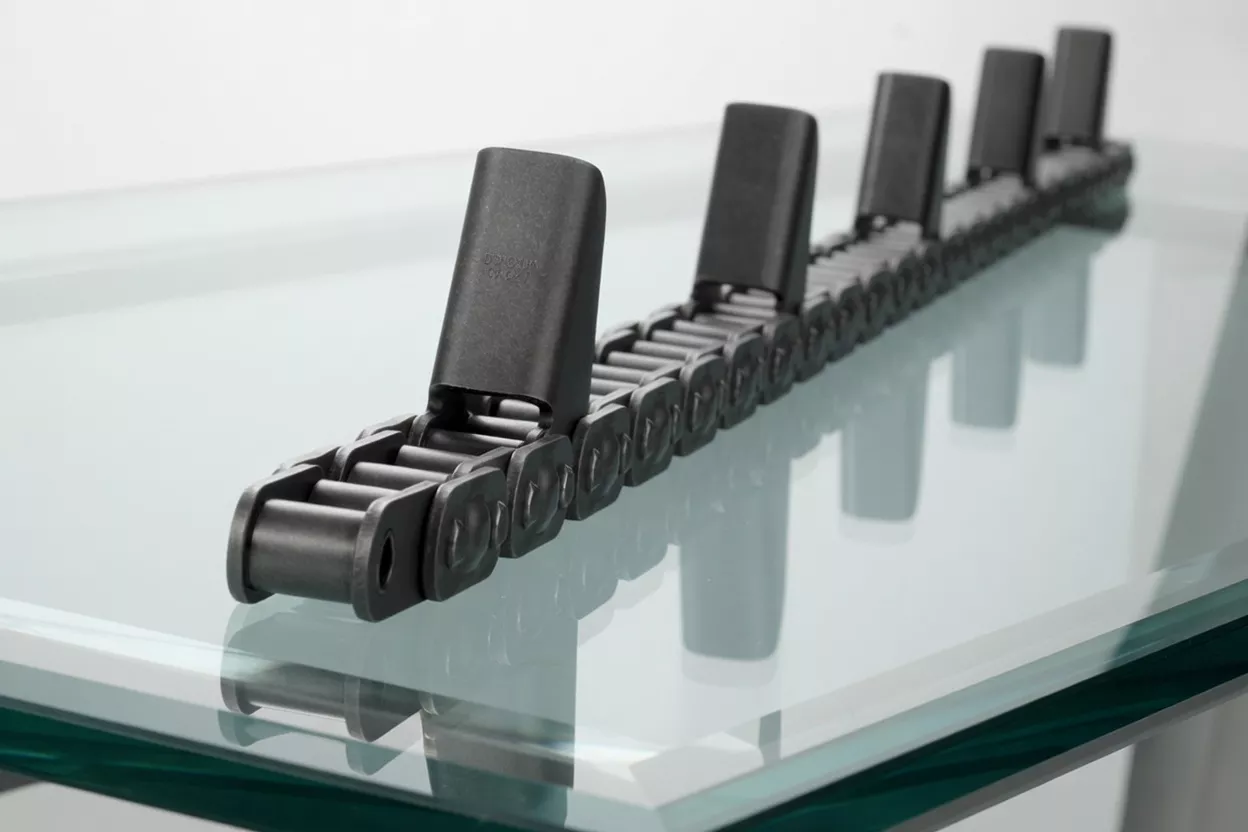
| Conveyor transfer | ANSI 60 or CA-series | Single or double-strand | Dust and fibre resistance | Pin-bushing seizure from lint accumulation |
| Basket augur / module | ANSI 80 double-strand | Double-strand | Sustained torque, dust tolerance | Roller fatigue from lint abrasion |
Cotton picker picking head chains are precision components. Substituting with a dimensionally similar chain from a different manufacturer without confirming pitch, roller diameter, and side plate thickness against the OEM specification introduces phase error risk. Always confirm against the OEM part number or supply a worn sample for reverse engineering before installing a replacement.
Australian Operating Conditions and Their Effect on Cotton Picker Chains
The Australian Cotton Belt — centred on the Namoi and Macintyre valleys in NSW and the Darling Downs in Queensland — combines several conditions that accelerate chain wear beyond what manufacturers’ standard service intervals account for.
Cotton harvesting in Queensland routinely occurs at 30–38°C ambient. At these temperatures, chain lubricant film thins and the fine lint dust that pervades the machine acts as a thermal insulator on drive components, preventing heat dissipation from heavily-loaded chain joints. Dry-film or food-compatible lubricants that resist lint adhesion perform significantly better than mineral oils in cotton harvester chain drives.
Australian cotton season demands maximum machine utilisation. A picker running 18–20 hours per day accumulates 400–600 hours over a season, much of it in continuous high-speed picking operation. Precision timing chains under these hours require measurement-based replacement scheduling rather than calendar-based intervals to maintain synchronisation accuracy.
The cotton lint that enters the chain drive housings is an aggressive abrasive when it accumulates between roller and sprocket tooth. Regular blowdown of chain housings with compressed air every 8–12 hours significantly extends picking head chain service life by preventing lint-packed abrasive accumulation between the roller contact surfaces.
Selection Criteria for Cotton Picker Replacement Chains
Cotton picker chain positions have tight tolerances. Confirm the OEM chain part number from the machine’s parts manual or the stamping on the existing chain’s side plate. For inline baler chains, confirm both chain standard and connecting link style — some baler configurations use proprietary connecting links that must be matched exactly.
On multi-stage picking head drives, replacing one chain in a multi-chain drive set without checking the others introduces phase imbalance. Measure all chains in a synchronized drive set simultaneously and replace as a matched set if any one exceeds the 1.0% elongation threshold.
The bale compression stroke in an inline baler generates peak loads far above continuous running load. SP-series (reinforced side plate) chain with through-hardened pins and shot-peened side plates resists the fatigue damage from these repeated peak-load cycles.
Standard wet lubricants attract and retain cotton lint, packing it into roller-tooth contact areas as an abrasive compound. Specify PTFE dry-film or food-grade synthetic lubricant for all cotton picker chain positions. Dry-film lubricants in cotton dust environments typically extend chain service life by 40–60% compared to mineral oil lubrication.
Maintenance Schedule for Cotton Picker Chains
Cotton picker chain maintenance must be adapted to the machine’s precision timing requirements and the lint-dust operating environment. Standard interval-based schedules are insufficient for precision picking head drives.
Blow down all chain housings with compressed air to remove lint accumulation. Inspect picking head drive chains visually for rollers with flat spots or damaged connecting links. Apply dry-film lubricant if required.
Measure picking head drive chain elongation across a 12-link span. Replace at 1.0% elongation. Check conveyor chains and baler chains at 1.5% elongation threshold. Inspect sprocket tooth profiles for hook wear and replace worn sprockets simultaneously with chains.
Disassemble and measure all chain positions. Replace any chain that ran through more than 300 hours of precision picking head duty. Confirm OEM part numbers for all replacements. Install new connecting links — never reuse connecting link cotters or retaining clips.
❓ Frequently Asked Questions
Explore Related Agricultural Drive Components
T-series, wide-angle CV and overrun-clutch protected drivelines that deliver tractor power into the chain drives of every implement.
Explore Drivelines →
⚙️ Agricultural Sprockets
Complete sprocket range including S-type, CA-type and ANSI roller chain sprockets to pair with every chain in this catalogue.
Explore Sprockets →
Specify the right chain for your machine
Tell us your application, operating environment, and machine model. We will recommend the exact chain and supply it with full material certification.