羊毛压榨机和羊毛打包设备的农业链条
Wool presses in Australian shearing sheds operate under a combination of constraints that make them one of the more difficult agricultural chain applications to specify correctly: the available space inside a wool press mechanism is extremely restricted, the torque required to compress a full wool bale at 180–200 kg/m³ density is very high, and the drive system must be compact enough to fit within the wool press cabinet without external chain guards that would impede shed operations.
This combination of high torque, compact geometry, and restricted maintenance access places chain specification requirements that demand both strength and compactness — typically achieved through duplex or triplex chain configurations using smaller-pitch, higher-strength alloy chain rather than single-strand large-pitch chain.
The Australian Operating Challenge
A wool press compressing 400 litres of raw fleece to a 200-litre pressed bale at 180 kg/m³ requires significant hydraulic or mechanical force through the press head. In mechanically-driven presses, this force is transmitted through a compact chain and sprocket system. The compact drive envelope limits the pitch diameter achievable, which means the chain must transmit the required torque at a smaller pitch diameter — placing higher per-link tension on the chain than the same torque transmitted through a larger-diameter drive.
The wool fibres that fill the press shed are extremely fine and highly penetrating. In a mechanically-driven wool press, wool fibres infiltrate chain joints continuously during operation. Fibre accumulation in chain joints first acts as a mild abrasive and subsequently acts as a wick that retains moisture against the steel surfaces, accelerating corrosion. Sealed rollers with grease-retained joint lubrication resist fibre infiltration better than open-roller standard chain.
Chain positions inside a wool press cabinet are typically accessible only with tools, making regular in-season lubrication difficult. Chain specification must therefore provide for extended lubrication intervals — either through grease-packed sealed joints, self-lubricating bushings, or a grease nipple system that allows external lubrication without chain access.
Chain Specification Reference
| Press Type | Chain Specification | Configuration | Lubrication Access | Replacement Interval |
|---|---|---|---|---|
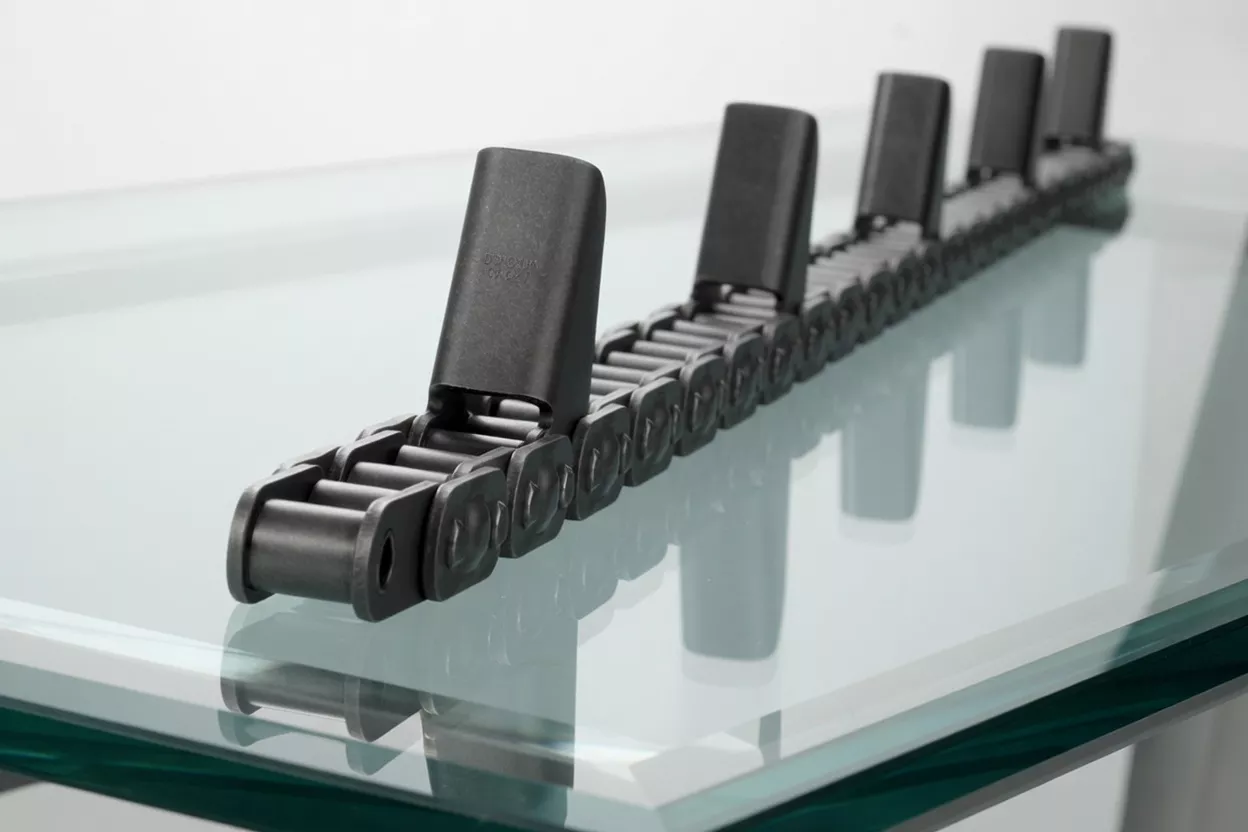
| Mechanical press — main ram drive | ANSI 80 or ANSI 100 triplex | Triple-strand for compact torque transmission | Grease nipple or sealed joints | Annual — pre-shearing season |
| Mechanical press — return drive | ANSI 60 duplex | Double-strand | Accessible for brush lubrication | Annual or 2.0% elongation |
| Conveyor to bin / tables | ANSI 50 single-strand | Single | Open access | 2.0% elongation |
❓ 常见问题解答
Explore Related Drive Components
Factory-matched sprockets engineered to run with our chain range — simplex, duplex, plate wheel and taper-bore in all standard pitches.
Explore Sprockets →
⚪ Bearings
Sealed pillow-block and flange-unit bearings for every shaft that carries a chain sprocket in your machine.
Explore Bearings →
Send us your application specifications
Our drive engineers confirm the correct chain type, pitch, and duty class for your machine and operating region.