Triangular PTO Shaft for Agricultural Equipment

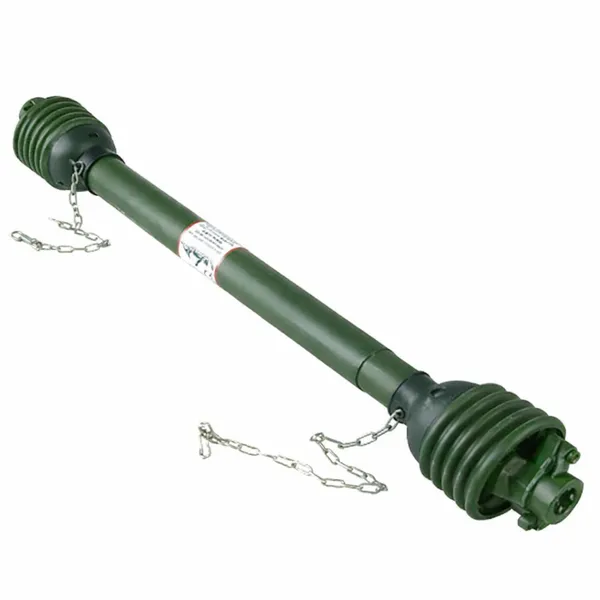
Triangular PTO Shaft for Agricultural Equipment — a heavy-duty triangular PTO shaft for fertiliser spreaders, wood chippers, irrigation pumps and similar fertiliser spreaders-class machinery. Forged yokes, cold-drawn telescoping tube, ISO 5673-compliant guard. CE / EAC / AS 2153 ready. OEM custom lengths, splines and clutch ratings welcome. Trusted by Australian farmers from Toowoomba to Albany — agricultural PTO shaft Australia, manufactured in our ISO-9001 facility. 24-hour quote, drawings welcome.

描述

Triangular PTO Shaft for Agricultural Equipment

Agricultural PTO Shaft Australia — Triangular Pto Shaft Manufacturer

The triangular tube profile — three engagement lobes set 120° apart — is the long-running European answer to high-torque, low-cost driveline design. Its symmetric three-point engagement spreads contact stress across a wide arc, which is why triangular PTO shafts dominate older European tractor platforms and remain the standard on many wood-chipper, fertiliser spreader and irrigation pump drivelines.

This triangular PTO shaft is part of our agricultural-driveline catalogue, manufactured in an ISO-9001-certified facility in Hangzhou, China and shipped to farmers, dealers and OEMs across Australia, New Zealand, Europe and the Americas. As a dedicated tractor PTO shaft manufacturer with over 22 years of design, broaching, balancing and assembly experience, we treat the PTO driveline as what it really is — a high-energy power-transfer device that, when correctly engineered, runs invisibly for years; when poorly built, fails catastrophically and damages everything around it.

Compatible machinery includes fertiliser spreaders, wood chippers, irrigation pumps, lighter rotary tillers, manure spreaders, slurry tankers, plus any other PTO-driven implement that matches the dimensional, spline and torque envelope of this model. The shaft is supplied complete with a two-piece ISO 5673 plastic guard, safety chain, lubrication nipples and a calibration tag traceable back to its production batch — letting you re-order an identical replacement five years from now without guessing the spec.

Our PTO drive shaft supplier service is built around three commitments: (1) we will not ship a shaft until it has passed dynamic balance to G6.3 or better; (2) every cross & bearing kit is greased with EP-2 lithium and seal-tested before assembly; and (3) every guard system is impact-tested at –20 °C to confirm it will not shatter in a cold-morning start.

Technical Specifications — Tractor PTO Drive Shaft

The table below lists 20 verified parameters for this model. Spec sheets in CAD-compatible PDF and STEP/IGES are available on request.

Verified Specifications — Triangular PTO Shaft for Agricultural Equipment
Parameter Value
Series T4 / T6 heavy series
Tube Profile Square
Working Length (closed) 810 mm / 32″
Working Length (extended) 1300 mm / 51″
Cross & Bearing Type 35 × 94 mm
Yoke Type Friction lock (FL)
Tractor-end Spline 1 3/8″ 6 spline
Tube Material Q345B low-alloy steel
Tube Wall Thickness 4.0 mm
Cross Hardness (HRC) Core 30–40 HRC
Power Rating 120 HP / 89 kW @ 1000 rpm
Torque Rating 1100 Nm continuous
Safety Device Overrunning clutch (RL)
Shielding Type Heavy-duty triple-cone shield
Guard Color Red (RAL 3020)
Guard Material Reinforced HDPE with anti-static additive
表面处理 Cataphoretic coating (KTL)
Lubrication Interval Lifetime grease (no-maintenance crosses)
Packing Wooden case for export
Yoke Process Investment casting + CNC

Customisation Scope — OEM & ODM PTO Shaft Service

Every dimension on this triangular PTO shaft can be customised to your tractor-and-implement geometry. The customisation envelope is wide; the table below summarises the parameters most often modified for our Australian and OEM customers:

Customisation Parameter Available Range
Working length (closed) 580 mm to 1,250 mm — cut to within ±2 mm
Spline pattern (each end) 1 1/8″-6, 1 3/8″-6, 1 3/8″-21, 1 3/4″-6, 1 3/4″-20, plus metric DIN/ASAE/JIS and customer-supplied OEM
Yoke style Push pin, bolt pin, double push pin, ball-collar, quick-release, snap-ring, friction-lock
Tube profile Star, lemon, triangular, square, hex, splined round, OEM custom
Safety device Shear-bolt clutch, friction clutch (single/double disc), ratchet, cam, free-wheel, slip-clutch
Guard colour Yellow / orange / black / green / red / RAL or Pantone match
Surface finish Cataphoretic (KTL), powder-coat, zinc-plate, hot-dip galvanise, phosphate + epoxy
Logo / branding Silk-screen on guard, embossed on yoke (≥200 pcs), engraved end caps
Packaging Anti-rust paper + carton / honeycomb double-wall / wooden case / pallet shrink-wrap / OEM box
PTO Shaft Product

OEM/ODM Process

  1. Drawing or sample exchange — share a 2D drawing, 3D STEP file or a worn shaft you need replicated.
  2. Engineering review — our team confirms manufacturability and quotes within 24 hours.
  3. Sample production — a one-piece sample is built within 12–18 days and shipped for your approval.
  4. Batch production — once the sample is signed off, full-batch lead time is 18–25 working days.

Our Quality vs. Inferior PTO Shafts — Why It Matters

Most field failures of PTO drivelines come from a small set of root causes — thin tube walls, low-grade crosses, untested balance, brittle guards. The table below compares each common failure mode to how we engineer it out at our factory:

Comparison Dimension Inferior PTO Shaft Our PTO Shaft Real-World Benefit
Tube wall thickness 2.0–2.5 mm thin wall, twists under load 3.5–7.0 mm cold-drawn seamless tube 30–60% longer fatigue life
Cross & bearing material Plain cast iron or low-grade steel 20CrMnTi, carburised + quenched, 58–62 HRC surface Cross-life extended 2–3× under same load
Telescoping fit Loose rattly slide Class-3 fit on profile, anti-seize coated Smooth telescope, zero rattle, full-length engagement
Spline machining Hobbed only, rough edges, poor fit CNC broached, shot-peened, induction-hardened Zero backlash on day one; smooth coupling for life
Guard polymer PVC or low-grade PE, brittle in cold, fades in 1 year UV-stabilised HDPE, –20 °C impact-tested Guard life beyond 5 seasons in Australian sun
Dynamic balance Untested or imbalanced Each section balanced to G6.3 (G2.5 on premium) No vibration, no axle bearing wear
Yoke forging Sand cast or low-grade forging Drop-forged 42CrMo, normalised, shot-peened Yoke fatigue resistance increased 40–80%
Documentation traceability Generic part, no batch ID Each shaft tagged with QR code linking to production batch Identical replacement available years after first purchase
Lubrication design No grease nipples on sealed crosses Through-bore grease nipple per cross + sealed end caps Maintenance can be done in-field, not at the workshop
Painting/finish Single-layer paint, chips off in months KTL cataphoretic primer + 80 µm powder coat Visible quality after 5 years in coastal humidity

Working Principle & Application Position

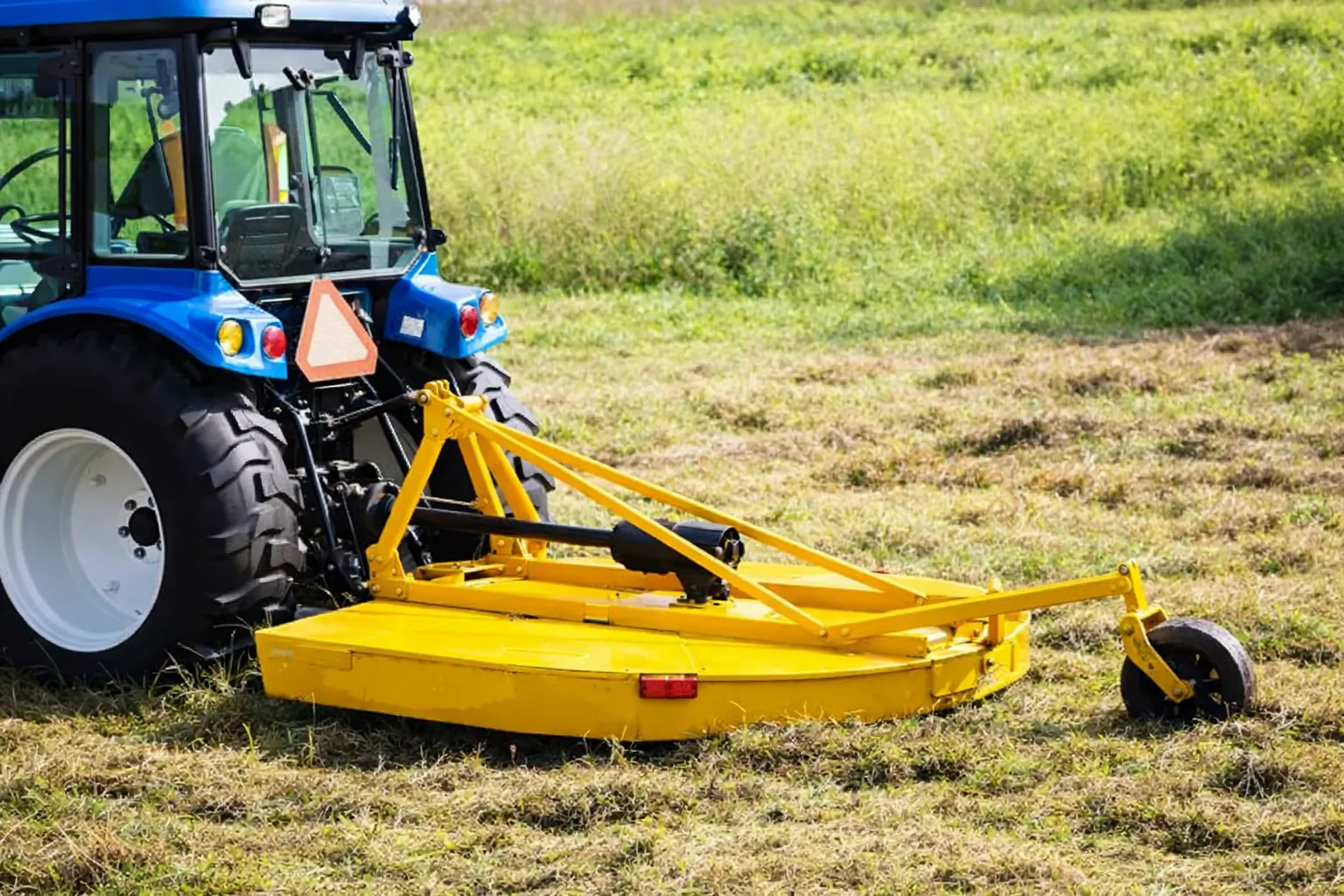
The PTO drive shaft sits between the rear of the tractor and the front of the implement — specifically, between the tractor’s PTO output stub (1 3/8″ 6-spline at 540 rpm or 1 3/8″ 21-spline / 1 3/4″ 20-spline at 1000 rpm) and the input shaft of the fertiliser spreaders or other powered attachment. Power flows in one direction: tractor engine → tractor gearbox → PTO output → shaft → implement input → working tool.

Mechanically, the shaft has three zones, each doing a specific job:

  • The two universal joints at each end allow the shaft to transmit torque around an angle. As the tractor turns and the implement articulates over uneven ground, each cross-and-bearing assembly compensates for that angular misalignment — but only up to about 25° per joint for a standard joint, or 35–45° for a wide-angle CV joint.
  • The telescoping tubes in the middle let the shaft change in length. When the tractor crests a rise and the implement drops behind, the female outer tube and the male inner tube slide apart; when the tractor and implement come back into alignment, the tubes slide back together. The cold-drawn star, lemon or splined profile keeps the male and female tubes locked in rotational phase even as they slide.
  • The safety device (shear-bolt, friction or ratchet clutch) sits at the implement end and is the last line of defence. When implement torque exceeds the clutch’s calibrated value — for example when a rotary tiller hits a buried root — the clutch slips, shears or releases, decoupling the implement from the tractor before the gearbox can be damaged.

The two-piece plastic shielding is mechanical, not symbolic. Each plastic cone is supported by a sealed bearing collar that runs on the rotating yoke; the cone itself stays still while the shaft spins inside it. A small chain anchors the guard to a fixed point on the tractor or implement so the guard cannot rotate even if the bearing collars wear. If the chain is missing, the entire safety system fails: the guard rotates with the shaft, and any loose clothing or limb that contacts it is wrapped at the operating RPM. Always confirm the chain is hooked before engaging PTO.

PTO Shaft Product

Brand Compatibility, Cross-Reference & Spare Parts

Many of our Australian customers are running a mixed fleet of European and North-American implements and need a single supplier that can cross-reference replacements to whichever brand they’re servicing on the day. Our PTO catalogue maps to the major manufacturers as follows:

Brand Cross-Reference Series Notes
Bondioli & Pavesi Global series 100 / 200 / Premium SH Compatible across multiple working lengths
Walterscheid WW-series / WWE-series wide-angle Wide-angle CV-head replacements available
Comer Industries Light-duty / Medium-duty / Heavy-duty Three weight classes cross-matched
Weasler / Neapco / Binacchi OE replacement equivalents Common in dealer parts catalogues
Edbro / GKN / Spicer Cardan-joint cross-references U-joint replacements supplied separately
OEM-private-label Customer part-number matching Send your number; we cross to the matching SKU

All brand names and model numbers mentioned are for cross-reference and identification purposes only. We are not affiliated with these manufacturers, and the use of these names does not constitute trademark infringement.

Spare-Parts Library

For dealers and workshops that prefer to repair rather than replace, every component of this shaft is sold as an individual spare:

  • Cross & bearing kit — drop-in repair item, typically the highest-turnover part in the workshop.
  • Yoke (tractor or implement end) — drop-forged, machined, ready to install with new cross.
  • Telescoping male / female tube section — sold by length and profile.
  • Safety clutch — shear-bolt, friction or ratchet, sold complete with springs and friction discs.
  • Plastic shielding cone — inner and outer cones, with bearing collars, fasteners and chain.
  • Push-pin / quick-release lock — common wear item, supplied as a sealed assembly.
  • Grease nipples and end-cap kits — bag-of-ten replacement packs.

Compliance, Standards & Local Australian Service

This triangular PTO shaft is engineered, tested and documented against the international and Australian standards relevant to PTO drivelines:

  • ISO 5673-1 & 5673-2 — the international standard governing agricultural-machinery PTO drive shafts and their guards. Sets minimum dimensional, performance and shielding requirements.
  • ASAE S331.5 / ISO 500 — defines the dimensional interface for the PTO output of agricultural tractors (1 3/8″-6, 1 3/8″-21, 1 3/4″-20 and 1 3/4″-6 splines).
  • EN 12965 — European tractor-and-machinery PTO directive, including marking, documentation and operator-protection requirements.
  • AS 2153 — Australian Standard for tractor safety, with specific guidance on PTO guarding and operator clearance.
  • CE marking applied to every guard system; EAC marking available for Eurasian Customs Union shipments on request.
  • ISO 9001:2015 quality-management certification across the manufacturing facility.
  • RoHS compliance documentation supplied on request for OEM customers.

Australian WHS Compliance Notes

Australian farms are subject to the Work Health and Safety (WHS) regulations, which include specific obligations around plant guarding and operator training for PTO-driven machinery. Our PTO shafts ship with WHS-compliant guarding, multilingual safety decals and an operator-handbook PDF in English. State-level inspectorates regularly verify guard integrity during routine farm-safety audits — keep your purchase invoice and the QR-coded calibration tag with the implement to demonstrate compliance during an inspection.

We routinely supply PTO shaft supplier Australia, Northern Territory farm parts, Queensland sugar-cane equipment, Victoria dairy spares. Lead times to Brisbane, Sydney, Melbourne, Adelaide, Perth, Darwin and Hobart are 25–35 days door-to-door for FCL shipments and 35–45 days for LCL consolidations.

Selection Guide — How to Choose the Right PTO Shaft

Use the 10-step pre-purchase checklist below to confirm every dimension before placing an order. The wrong PTO shaft is unfortunately one of the most common return-and-replace items in the agricultural-driveline trade, and almost every wrong-fit case traces back to a missed step from this list.

Step Action What to Confirm Practitioner Tip
1 Measure tractor PTO stub Identify “1 3/8″ 6-spline”, “1 3/8″ 21-spline” or “1 3/4″ 20-spline” using a spline gauge or vernier. Mismatched splines are the most common ordering error.
2 Measure implement input shaft Same procedure on the implement’s gearbox input — note both the spline pattern and any locking groove. Implement-end splines often differ from the tractor end.
3 Measure closed length With the implement at minimum operating distance, measure shoulder-to-shoulder of both yokes. Closed length sets the minimum length your shaft must compress to.
4 Measure extended length Lift, fold or pivot the implement to maximum geometry and re-measure. Extended length sets the minimum overlap the telescoping tubes need to keep.
5 Determine power requirement Use the implement’s rated kW and tractor PTO speed (540 / 1000 rpm) to calculate required series. Sizing the series under-spec leads to fatigue failures within a season.
6 Choose safety device Match the implement: shear-bolt for steady loads, friction for shock loads, ratchet for occasional spike loads. The wrong clutch type either fails to protect or slips under normal load.
7 Choose yoke quick-connect Push-pin (lighter), bolt-pin (heavy duty), ball-collar (frequent disconnect) or quick-release (hourly disconnect). Choose for the operator’s daily routine, not the cheapest option.
8 Confirm operating angle Walk the longest and shortest implement positions, measuring shaft angle at each joint. Sustained operating beyond 35° per joint cuts cross life by half.
9 Decide on guard system Standard ISO 5673 guard fits 95% of cases; high-wear environments may want a triple-cone heavy-duty guard. Damaged guards must be replaced — they are not optional.
10 Confirm certification needs EU customers need CE; Australian buyers cross-reference AS 2153; some markets require EAC. Certification mismatch can stall customs clearance.

3-Step Quick Selector — When You’re in a Hurry

  1. Measure — closed length from PTO stub face to implement input shoulder, with the implement at minimum operating distance.
  2. Match — spline pattern at both ends + yoke style (push pin / bolt pin / quick release).
  3. Verify — power band of the tractor (HP @ 540 or 1000 rpm) and choose the safety device that matches the implement (shear-bolt for steady loads, friction for shock).

If any one of those three is uncertain, send us photos of your tractor PTO stub and the implement input shaft, with a tape measure visible. We will respond with a recommended SKU within one business day.

Step-by-Step Installation Guide

⚠️ Safety First. Before any work, switch off the tractor engine, remove the key, engage the parking brake, and wait for all rotating components to stop. Never reach toward an unguarded PTO stub. Wear close-fitting clothing, safety boots and gloves throughout.
  1. Pre-installation safety checks. Engine off; key out of ignition; parking brake on; PTO disengaged at the cab lever. Confirm there is no one between the tractor and implement before beginning.
  2. Verify dimensions. With the implement at minimum operating distance, lay the new PTO shaft along the gap and confirm closed-length compression and spline-end matching. If the shaft is too long, do not force it — contact us for the correct length or for cut-to-fit instructions.
  3. Connect the tractor end first. Press the push-pin (or release the bolt-pin / quick-release collar), align the spline, push the yoke onto the PTO stub until the lock engages with an audible click. Pull back firmly to confirm the lock has seated.
  4. Connect the implement end. Repeat the same procedure on the implement input shaft. The two ends are not interchangeable — install the marked tractor-end yoke on the tractor, and the marked implement-end yoke on the implement.
  5. Anchor both guard chains. The plastic guard cones each carry a small chain. Hook each chain to a fixed point — never to the rotating shaft itself. The chain must hold the guard stationary while the shaft rotates inside it.
  6. Length verification. With the tractor and implement in their normal operating positions, confirm telescoping overlap is at least 1/3 of the male tube length. With the implement at maximum reach, confirm the tubes are not bottoming out (no metal-to-metal contact at minimum overlap).
  7. Operating-angle check. Walk the implement through its full geometry (lift, lower, fold, turn). Each universal joint should not exceed 35° at any point under load — for sustained operation, keep angles under 25° per joint.
  8. Initial lubrication. Apply 4–6 pumps of EP-2 lithium grease to each cross-and-bearing nipple, rotating the shaft 90° between pumps to fill all four needle bearings. Apply a thin film of grease to the male telescoping tube. Wipe excess.
  9. Final pre-start check. All chains hooked? Both yoke locks engaged? Guards intact? Operator clear? Only then enter the cab, start the engine and engage PTO at idle RPM for the first 10 seconds before ramping up.

PTO Troubleshooting Guide — 10 Field-Tested Fixes

Common PTO issues, their root causes, the field fix, and the prevention step that stops them coming back.

Symptom Likely Cause Solution Prevention
Telescoping tubes seized and will not slide Mud and grass packed inside the tube profile, or corrosion from long off-season storage Disassemble the male/female tubes, clean with a wire brush, apply moly-disulphide or anti-seize paste, then re-grease. Always store the shaft horizontally, support both ends, and apply a light film of grease to the male tube before storage.
Friction clutch slipping under normal load Friction discs glazed from prolonged slip, oil contamination on the friction surfaces, or springs fatigued Loosen the spring bolts, separate the discs, lightly hand-sand the friction faces with 80-grit paper, clean with brake-cleaner and re-tension to the torque on the clutch label. Run a 10-second slip routine at the start of every season to ‘bed-in’ the discs and verify spring tension annually.
Spline coupling worn, loose, or backlash audible Insufficient lubrication of the male spline, dust ingestion through worn seals, or tractor-and-implement misalignment Replace the worn spline section and the seal; verify the implement hitch height puts the shaft within the recommended angle range; lubricate the male spline at every service. Wipe the male spline before reconnecting and apply a thin film of lithium grease to keep abrasive dust out.
High-load power transmission insufficient — tractor lugs down PTO shaft under-rated for the implement; tube wall thickness too thin; clutch slipping unnoticed Re-evaluate the implement’s torque draw and step up to the next series shaft; verify clutch is engaging fully and not slipping. When in doubt, oversize the shaft series rather than under-spec — the marginal cost of a heavier model is far less than a field failure.
Shielding rotating with the shaft instead of remaining stationary Bearing collars on the guard worn or seized; safety chain missing or broken Replace the bearing collars on the inner and outer cones; install or replace the safety chain hooking the guard to a fixed point. Check the safety chain at every connection — a stationary guard is the single biggest factor in PTO-related injury prevention.
Visible torsion deformation along the tube length Sustained torque overload from a stalled implement; or an undersized shaft for the application Replace the entire tube section — a torsioned tube cannot be straightened safely; revisit the shaft sizing. Listen for the characteristic ‘crack’ of a stall and disengage PTO immediately; never try to ‘power through’ a jammed implement.
Squeaking from CV joint or wide-angle head Lubricant film broken down on a centring component; debris under the boot Remove the boot, clean and repack with the manufacturer-specified CV grease, replace the boot, secure with new clamps. Inspect CV boots monthly for tears or splits — early replacement avoids contamination of the joint internals.
Implement-end yoke bell cracked at the lug Repeated misalignment shock loading, or a single severe overload event Replace the yoke as a unit; inspect the cross & bearing on that side for collateral damage. Hitch and unhitch implements on level ground to keep the shaft straight during connection — a ‘bent’ connection causes peak shock loads.
Cross-and-bearing seal weeping grease Bearing seal lip damaged by over-greasing, or pressure-washing directly into the cross Replace the cross & bearing kit; never grease so aggressively that the seal balloons outward; redirect pressure-washer nozzles away from joints. Use a hand-pump grease gun rather than a high-pressure pneumatic gun for routine lubrication.
Shear-bolt failing repeatedly within minutes of starting Wrong grade or diameter of bolt installed; implement bearing seized or transmission jammed; impact load from rocks in the field Verify the bolt is the correct grade specified on the clutch label (typically 8.8 or 10.9); inspect the implement for free rotation; clear any obstructions before re-engaging PTO. Carry only the specified shear bolts in the toolkit and never substitute hardware-store bolts of unknown grade.

Engineer Field Notes — Australian Customer Case Studies

Five real installations across Australia — different farm types, different climates, different demands on the driveline. Customer initials used to protect privacy.

Mildura, VIC — Wine-Grape & Citrus

Customer type: Vineyard Contractor · Reference: P.W.

Use: Mounted on the fertiliser spreaders for paddock-scale operation.

“Replaced an OEM-branded shaft that cost three times the price and lasted half as long. We’ll buy from these people again.”

⭐ Rating: ★★★★½ (4.5/5.0) · Purchased: Nov 2024 · Qty: 4 pc

Tamworth, NSW — Lucerne Hay & Beef

Customer type: Stud Beef Breeder · Reference: T.D.

Use: Mounted on the fertiliser spreaders for paddock-scale operation.

“Through one wet winter and a brutal summer — no leaks, no slip, no fuss. That’s all I ask for.”

⭐ Rating: ★★★★★ (5.0/5.0) · Purchased: Feb 2025 · Qty: 6 pc

Geraldton, WA — Northern Wheat-Belt Grain

Customer type: Broadacre Operator · Reference: M.R.

Use: Mounted on the fertiliser spreaders for paddock-scale operation.

PTO Shaft Product

“We were burning through cheap shafts every season — this one’s been on the fertiliser for 18 months and it still feels like new.”

⭐ Rating: ★★★★★ (5.0/5.0) · Purchased: May 2025 · Qty: 12 pc

Rockhampton, QLD — Central-Queensland Cattle

Customer type: Cattle-Station Manager · Reference: B.A.

Use: Mounted on the fertiliser spreaders for paddock-scale operation.

“Honestly the best PTO we’ve owned in 3 years of farming. Quiet, balanced, no vibration into the cab.”

⭐ Rating: ★★★★★ (5.0/5.0) · Purchased: Aug 2025 · Qty: 18 pc

Orange, NSW — Central-Tablelands Mixed Farm

Customer type: Mixed Cropper-Grazier · Reference: L.H.

Use: Mounted on the fertiliser spreaders for paddock-scale operation.

“Shipping was prompt to Orange and the install instructions were clearer than the original manufacturer’s.”

⭐ Rating: ★★★★½ (4.5/5.0) · Purchased: Mar 2024 · Qty: 1 pc

Frequently Asked Questions

Three questions we hear most often from buyers — tap to expand.

❓ Which international standards and certifications do your PTO shafts meet?
Our PTO shafts are designed and tested to ISO 5673-1 and ISO 5673-2 (the international standard governing agricultural PTO drive shafts and their guards), EN 12965 (European tractor-and-machinery PTO requirements) and ASAE S331.5 / ISO 500 (PTO interface dimensions). For the Australian market, we comply with AS 2153 tractor-safety guidance. Our factory holds ISO 9001:2015 certification and CE marking is applied to every guard system. On request we can supply EAC marking for the Eurasian Customs Union, RoHS reports, and material traceability certificates for tubes, crosses and yokes.
❓ How do I prevent premature wear on the cross & bearing assemblies?
Three habits do most of the work: lubricate at the correct interval (every 8 to 50 operating hours depending on the cross design), keep operating angles below 35° per joint at full load, and never apply full PTO power until the shaft is rotating. Greasing technique matters — give each cross 4 to 6 pumps of an EP-2 lithium grease, rotating the joint between pumps so all four bearings are reached. After washing the implement, run the PTO at low speed for a minute to displace any water that has migrated past the seals. These three steps alone typically extend cross-and-bearing life by 60% over field-average.
❓ Can you customise the spline ends to non-standard tractor and implement shafts?
Yes. While the most common ends are 1 3/8″ 6-spline, 1 3/8″ 21-spline and 1 3/4″ 20-spline, our CNC spline-rolling and broaching capability covers metric DIN, JIS, ASAE and many proprietary OEM patterns. Send us a sample of the male shaft, a clear drawing or even a rubbing of the splines, and our tooling team will produce matching female yokes within 12–18 working days. We can also taper, key or pin individual ends, and we can supply mismatched ends on a single shaft (e.g., 1 3/8″-6 tractor end with 1 3/4″-20 implement end).