Heavy-Duty Sprockets for Sugarcane Harvester Drive Systems — Engineered for Queensland Conditions
Sugarcane harvesting in Queensland operates under conditions that push chain-and-sprocket drive systems to their limits. The combination of wet coastal soils, the abrasive silica and basalt particles embedded in Queensland’s cane field soils, the heavy mud loading carried into the machine on mature stalks, and the intensive mill-schedule-driven operating cycles creates a wear environment that consumes standard sprockets faster than virtually any other agricultural application in Australia.
Beyond the wear challenge, cane harvester drive systems present a sourcing problem that plagues Queensland machine owners: the sprocket specifications used on cane harvesters — base cutter drives, elevator drives, and top chopper systems — are frequently non-standard, heavy-duty configurations that are not available from general agricultural parts distributors. When a base cutter drive sprocket fails mid-harvest and the nearest stocking distributor has nothing to fit, the machine stays parked and the mill contract goes unfulfilled. We solve both problems: we manufacture to the correct heavy-duty specification for Queensland cane harvester duty, and we supply direct from our manufacturing facility with air freight capability to far north Queensland within days.
Understanding the Queensland Cane Harvester Wear Environment
To specify the correct sprocket for a cane harvester drive position, it is necessary to understand why Queensland conditions produce wear rates that are 3–5 times what the same sprocket would experience in European or North American agricultural applications.
The coastal and hinterland soils of the Queensland cane-growing regions — from the Wet Tropics around Cairns and Innisfail, through the Burdekin Delta, to the Sunshine Coast hinterland — contain basalt-derived soils with significant fine silica and rock fragment content. These particles are carried into the harvester on the base of cane stools and in soil thrown by the base cutter. They lodge between sprocket teeth and roller surfaces, creating the three-body abrasive wear that is the primary failure mechanism for base cutter and elevator sprockets in Queensland operations.
Queensland harvest regularly occurs in wet-to-saturated field conditions as the mill intake schedule cannot wait for soils to dry. Mud carried into the elevator on cane billets is pressed into the chain-sprocket interface by the tension load, creating an abrasive paste of silica particles in clay-water matrix that is 4–6 times more abrasive than dry soil on sprocket tooth surfaces. Additionally, bagasse juice — mildly acidic at pH 4.5–5.5 — wets all accessible sprocket surfaces and promotes corrosion between lubrication intervals.
Cane harvesters in Queensland operate under mill crushing schedules that effectively mandate continuous operation for the duration of the harvest window — typically 16–18 hours per day for 20–28 weeks in major growing regions. A harvester completing a full Queensland season accumulates 2,500–3,500 hours of heavy-duty operation, compared to 600–900 hours for a typical Australian grain harvester. Sprocket service intervals must account for this far higher annual hour accumulation.
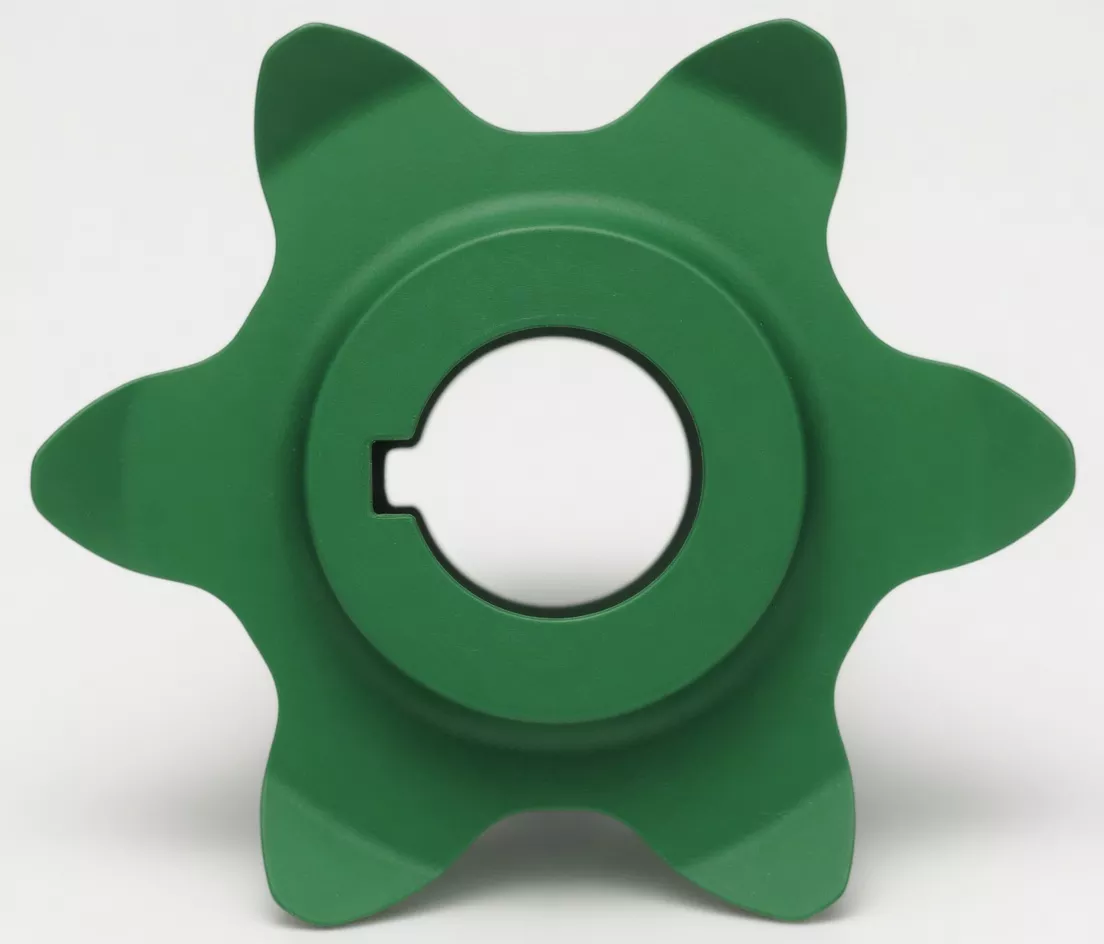
Cane harvester drive systems use heavy-duty chain specifications — ANSI 100 SP, ANSI 120, and proprietary heavy roller chain standards — that are outside the standard agricultural parts catalogue range. Sprockets for these drives have wide hubs, large bore diameters, and tooth profiles designed for the high-load, high-abrasion cane environment. These configurations are not available from general agricultural distributors and must be sourced from specialist manufacturers.
⚙️ Drive Positions on a Sugarcane Harvester
A modern sugarcane harvester — whether a John Deere CH570, a Case IH A8800, or a Cameco-Austoft type — runs six to eight major chain-and-sprocket drive positions simultaneously. Understanding each position’s load and environment is essential for correct sprocket specification.
Drives the counter-rotating base cutting discs from the primary reduction gearbox. The base cutter is the highest-shock-load drive on the machine — the cutting discs engage the full stalk at ground level, including buried stool bases, soil, and occasionally rocks or rattle cane debris. Double-strand ANSI 120 or ANSI 140 SP with SAE 4140 alloy steel and induction hardening to HRC 52–58 is the correct specification. Split sprocket configuration is often required for in-situ replacement without full base cutter removal.
Drives the primary elevator chain that conveys cane billets upward from the chopper drums through the primary extractor. The elevator chain runs through the densest concentration of mud, bagasse, and abrasive particles on the machine. Sprocket teeth must resist the combination of tooth flank abrasion from mud-contaminated chain and the impact loads of the billet stream. Case-hardened or induction-hardened S-type or CA-type elevator sprockets.
Drives the counter-rotating top chopper that removes the growing tip and top leaves before the base cutter engages. The top chopper encounters the highest-speed impact loads on the machine — large-diameter tops at harvesting speed. Sprocket specification: double-strand ANSI 100 SP with induction hardening.
The secondary elevator and extractor system runs in cleaner material than the primary elevator but still in bagasse-dust and fine soil particle conditions. CA-type or S-type elevator sprockets with case-hardened specification. These positions have less abrasive exposure and typically run at lower duty than the primary elevator.
Cane Harvester Sprocket Specification Reference
| Position | Chain Standard | Typical Configuration | Material | Hardness | Queensland-Specific Note |
|---|---|---|---|---|---|
| Base cutter drive | ANSI 120 SP or ANSI 140 | Double-strand, split option | SAE 4140 alloy | Induction hardened HRC 52–58 | Most critical position — never undergrade |
| Top chopper drive | ANSI 100 SP double-strand | Double-strand | SAE 4140 or 1045 heavy | Induction hardened HRC 50–56 | High-speed impact — shock load rated |
| Primary elevator (head) | S55/S62 or CA620 type | Single or double-strand | SAE 1045 carbon steel | Case/induction hardened HRC 48–54 | Abrasion from mud-laden billet stream |
| Primary elevator (boot) | S55/S62 or CA620 type | Single or double-strand | SAE 1045 carbon steel | Case hardened HRC 45–52 | Same standard as head sprocket |
| Secondary elevator | CA550 or CA555 | Single-strand | SAE 1045 carbon steel | Case hardened HRC 45–52 | Lower abrasion than primary — standard case hardened sufficient |
| Chopper drum / billet cutter | ANSI 80 or ANSI 100 | Double-strand | SAE 1045 carbon steel | Case hardened HRC 45–52 | Regular inspection — billet impact wears tooth tips |
| Fan / extractor drive | ANSI 80 double-strand | Double-strand | SAE 1045 carbon steel | Case hardened HRC 45–52 | Moderate duty — standard spec appropriate |
Our Custom Manufacturing Capability — Solving the Queensland Supply Problem
The most common complaint from Queensland cane harvester operators about sprocket supply is not quality — it is availability. Non-standard heavy-duty configurations, split sprocket requirements, and large bore dimensions mean that the correct part is simply not available locally when it is needed. We address this in three ways:
Our standard export packing and customs documentation are prepared for every order as a matter of course — not as a premium service. For urgent harvest-season requirements, we can dispatch express air freight from our factory within 48 hours of order confirmation, typically arriving in Cairns, Townsville, or Mackay within 4–7 days of dispatch. We have supplied emergency sprocket orders to Queensland cane operations with this timeline multiple times.
We manufacture split sprockets, large-bore configurations (up to 200 mm bore diameter), and non-standard tooth counts from worn samples or drawings. Our minimum order for custom cane harvester sprockets is 5 pieces — accessible for single-machine owners as well as mill-associated workshop suppliers stocking for multiple machines. Lead time for custom manufacturing: typically 3–5 weeks from confirmed drawing or sample receipt.
Mill-associated workshop suppliers and agricultural dealerships in Queensland’s cane regions can work with us to establish a stock-to-order parts program — we hold inventory of their highest-turn specifications at our facility and dispatch on request with short lead times. This eliminates the local inventory carrying cost while maintaining supply availability.
We accept worn or broken sprocket samples for reverse engineering. Even heavily worn sprockets retain sufficient dimensional information (hub diameter, bore, overall diameter, and tooth count) to produce an accurate replacement drawing. Our engineering team measures, documents, and manufactures from the sample within the standard custom lead time.
Customer Cases — Queensland Cane Operations and Global Cane Processors
A Burdekin cane grower running a John Deere CH570 had experienced two base cutter drive sprocket failures in consecutive seasons from tooth fracture under the heavy basalt-soil conditions of their river flat paddocks. After switching to our SAE 4140 induction-hardened base cutter sprockets, they completed a full Burdekin season — including the heavy wet-condition early-harvest period — without a drive failure. “The base cutter sprockets have held up through the worst of the basalt gravel paddocks without a tooth failure. That alone has paid for several years of supply from your company.” ⭐⭐⭐⭐⭐
A custom harvesting contractor in Far North Queensland running two Case IH A8800 harvesters sources all elevator and base cutter sprockets from us with an air freight standing arrangement. “The supply reliability is the biggest advantage. Before we set up the air freight arrangement with you, a sprocket failure meant the machine was down for a week waiting for parts from Brisbane. Now it is four to seven days from your factory to our shed — that is the difference between one lost harvesting day and seven.” ⭐⭐⭐⭐⭐
A large São Paulo state sugarcane processing group running 45 harvesters sources replacement elevator and base cutter sprockets from us for their workshop stock. “Your ability to supply the large-bore, heavy-duty configurations that our Cameco and Case IH harvesters require — at competitive pricing with full material certification — is something we have not found with any other supplier at this combination of specification and price.” ⭐⭐⭐⭐⭐
A KwaZulu-Natal cane cooperative supplying replacement sprockets to multiple grower-members uses our range for John Deere and New Holland harvester specifications. “The documentation you supply — material certificates, hardness test records, dimensional inspection reports — allows us to demonstrate to our quality-conscious grower members that the specification matches the OEM standard they are accustomed to.” ⭐⭐⭐⭐⭐
A Colombia Valle del Cauca sugarcane processor running a mixed fleet of Cameco and Case IH harvesters sources our full sprocket range for their workshop. “The combination of competitive pricing and technical capability — particularly the ability to produce split sprockets and large-bore configurations from our drawings — makes your company uniquely capable of supporting our workshop’s full sprocket requirement.” ⭐⭐⭐⭐⭐
Complete Your Cane Harvester Drive System
S-type, CA-type, and ANSI roller chains matched to every sprocket in our range — same standards, same quality grade, same manufacturer.
Explore Chains →
⚡ PTO Shafts & Drivelines
Wide-angle CV and T-series drivelines connecting tractor PTO to every implement chain drive we serve.
Explore Drivelines →
⚙️ Agricultural Gearboxes
Right-angle and parallel-shaft gearboxes forming the upstream reduction stage for PTO-driven chain-and-sprocket implement drives.
Explore Gearboxes →
❓ Frequently Asked Questions
Tell Us Your Sprocket Specification
Our engineering team responds within 24 hours. Send us an OEM part number, a worn sprocket sample, or your machine’s make and model — we will confirm the correct specification, provide full material documentation, and deliver at 30–50% below OEM price.
✈️ Express air freight to Australia available for urgent seasonal requirements.