Agricultural Chains for Air Seeders: Precision Drive Solutions for Broadacre Planting
Australian broadacre farming operates at a scale where small seeding errors have large consequences. An air seeder covering 6,000 hectares in a two-week planting window — distributed across the Riverina, the Murray Mallee, or the Wheatbelt — must maintain seed metering accuracy from the first paddock to the last. The seed metering drive chains and bin auger chains that govern rate delivery are the mechanical links between the operator’s rate setting and the seed that enters the soil. Any elongation, wear, or inconsistency in these chains translates directly into population variation across the paddock.
This guide covers the specific chain requirements of air seeders — seed metering drives, ground drive wheel transmissions, bin auger chains, and fan drive systems — with attention to the precision requirements and the field longevity demands of Australian large-scale planting operations.
⚙️ How Chain Drives Govern Seeding Accuracy
On a mechanical rate-control air seeder, the seed metering drive chain is the primary mechanical link between the seeder’s ground wheel and the metering units. As the seeder moves forward, the ground wheel turns the drive shaft, which drives the chain, which turns the metering rolls at a calibrated speed ratio that delivers the target seeding rate. This is a precision timing chain system — any elongation changes the effective transmission ratio, meaning the metering rolls turn slightly slower or faster than designed, and the actual seeding rate drifts from the calibrated target.
A seed metering drive chain that has elongated 1.5% does not deliver 1.5% less seed — the effect is non-linear because worn chains in worn sprockets also exhibit speed variation as the chain articulates through high-wear tooth profiles. The practical effect is seeding rate variation of 2–4% at 1.5% chain elongation — significant in precision agronomy programs where target populations are set to the nearest 5 plants/m².
Chain Drive Positions on an Air Seeder
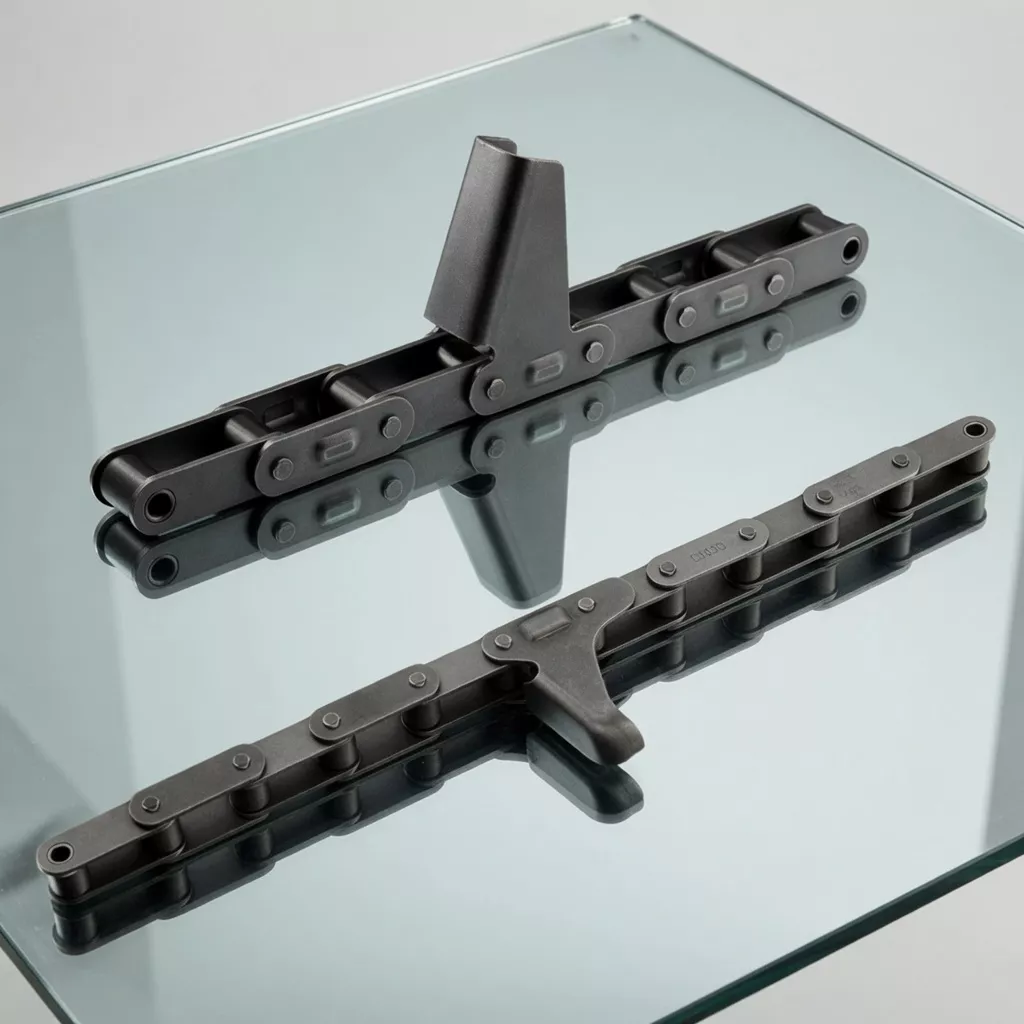
The primary precision chain on the machine. Connects the ground drive wheel transmission to the seed metering system. Chain elongation at this position directly affects delivered seeding rate accuracy. Short-pitch ANSI 40 or ANSI 50 chain with tight manufacturing tolerance is the standard specification.
Drive the bin fill and tank-to-airstream transfer augers. These see higher loads than the metering drive — particularly during high-flow rate seeding of dense grain cereals — and must resist the abrasive action of fine grain dust and coating particles used in seed treatments. ANSI 60 or ANSI 80 as appropriate to fan drive power.
The ground wheel to main jackshaft drive chain transmits the full mechanical energy from tractor motion to the seeder drive system. Typically double-strand ANSI 60 or ANSI 80, this chain must maintain accurate drive ratio over thousands of hectares of operation.
Some precision seeders use chain-driven depth and down-pressure adjustment systems. These are light-duty chains — ANSI 35 or ANSI 40 — but their failure causes seeding depth inconsistency that affects establishment uniformity across the paddock.
Chain Specification Reference for Air Seeder Applications
| Drive Position | Chain Standard | Precision Requirement | Replacement Threshold | Notes |
|---|---|---|---|---|
| Seed metering drive | ANSI 40 or ANSI 50 | Max 0.8% elongation | 0.8% measured at 12-link span | Replace as matched set across all metering drives |
| Ground drive transmission | ANSI 60 / ANSI 80 double | Max 1.5% elongation | 1.5% elongation | Check sprocket for hook wear at same service |
| Bin auger drive | ANSI 60 single or double | Max 2.0% elongation | 2.0% elongation | Inspect for abrasive grain dust wear on rollers |
| Fan drive | ANSI 80 double-strand | Max 1.5% elongation | 1.5% elongation | Monitor for vibration indicating roller fatigue |
| Depth adjustment drive | ANSI 35 / ANSI 40 | Functional accuracy | 1.5% elongation | Light duty — replace with main drive service |
Why Australian Seeder Operations Demand Tighter Wear Tolerances
A seeder working at 6 km/h with a 20-metre bar covers 1.2 hectares per minute. Chain wear that shifts the seeding rate by 3% accumulates across hundreds of hectares before the error is detected — often only at emergence when corrective action is no longer possible. Tighter wear tolerance management prevents the small drift from becoming a paddock-scale problem.
Australian precision agronomy uses increasingly complex seed coating systems — fungicide, insecticide, biological and polymer coatings applied in multiple layers. These coating particles are often harder than bare grain and accelerate abrasive wear on the metering drive chain and sprocket teeth that are in proximity to seed flow.
Variable-rate seeding programs based on EC mapping change seeding rate multiple times per paddock, requiring the mechanical transmission to respond accurately to each rate change. A worn chain with slack and play introduces hysteresis into the rate response — the actual rate lags behind the target rate on acceleration, and overshoots on deceleration.
Selecting Replacement Chains for Air Seeder Applications
The seed metering drive chain is the highest-precision component on the seeder. Replace it at 0.8% elongation — tighter than the standard 1.5–2.0% threshold used for other agricultural chain positions. Measure at the start of every planting season and at the midpoint if seeding duration exceeds 200 hours.
On multi-row seeders with individual metering drives on each section, chains that have run different hours or at different wear rates will deliver different seeding rates from section to section. Replace all metering drive chains from the same production batch at the same service to prevent between-section rate variation.
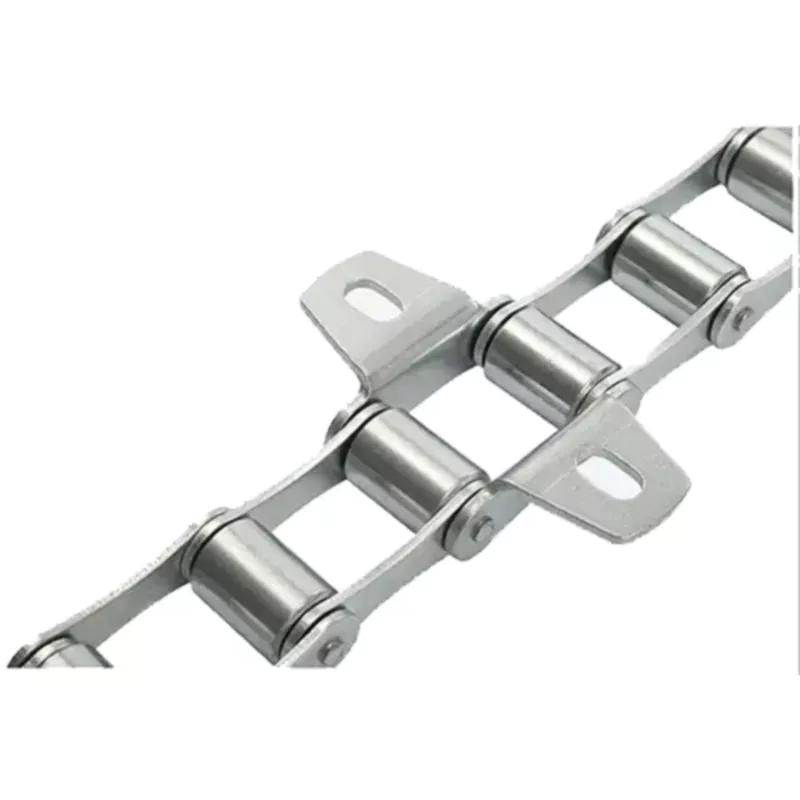
Air seeder metering chains are precision components. The manufacturing pitch tolerance affects the effective transmission ratio — confirm the chain pitch tolerance (typically +/- 0.5% for precision agricultural chain vs +/- 1.5% for standard industrial chain) matches the OEM specification before ordering.
Standard mineral chain lubricant attracts and retains seed coating particles that act as abrasive compound on metering drive chains. Specify dry-film (PTFE or graphite) lubricant for all chains in proximity to seed flow and metering components.
Maintenance Schedule for Air Seeder Chains
Measure all chain elongation using a precision gauge or rule across a 12-link span. Replace metering drive chains at 0.8% elongation, all other chains at 1.5%. Run the seeder on a simulated pass and check for visible slack, jumping, or noise from any chain position.
Re-measure metering drive chains. Clean grain dust accumulation from all sprockets and chain housing surfaces. Check ground drive and bin auger chain tension. Blot metering drive chain dry before applying dry-film lubricant.
Remove all chains. Clean, inspect for roller fatigue or side plate surface cracking. Store in a dry environment with a light protective oil coat. Note the hours and elongation reading for each chain to inform pre-planting replacement decisions for the next season.
❓ Frequently Asked Questions
Explore Related Agricultural Drive Components
Slasher, mower, tiller and custom-ratio gearboxes that drive the chain systems inside PTO-powered implements.
Explore Gearboxes →
⚡ PTO Shafts & Drivelines
Matched drivelines from T1 to T8 rating that feed the chain input sprocket on every PTO-driven machine we serve.
Explore Drivelines →
Enquire about matched chain-and-sprocket kits
We supply chain and sprockets together as matched sets — same standard, same quality grade, ready for immediate installation.