High-Temperature Abrasion-Resistant Sprockets for Biomass Pellet Mill Drive Systems
Australia’s biomass energy sector — converting agricultural residues including wheat straw, canola stubble, cotton gin trash, bagasse, and sawmill offcuts into high-density fuel pellets — has grown significantly as renewable energy policy creates demand for domestic pellet fuel. Biomass pellet mills impose a combination of operating conditions on their chain-and-sprocket drives that few agricultural applications match: sustained operating temperatures of 60–100°C from the pelletising process heat, continuous abrasive dust from ground crop residue, and the high sustained torque of forcing fibrous material through a die under pressure.
The failure modes are specific to this environment. Thermal fatigue — the cracking of tooth flanks caused by repeated heating and cooling of the steel surface — occurs in biomass pellet mill drives that run at elevated temperature without adequate heat-resistant specification. Abrasive wear from biomass dust infiltrating the chain-sprocket interface removes tooth material at rates far above standard agricultural wear assumptions. And seal failure from the combination of heat, dust, and vibration exposes bearing surfaces that were previously protected.
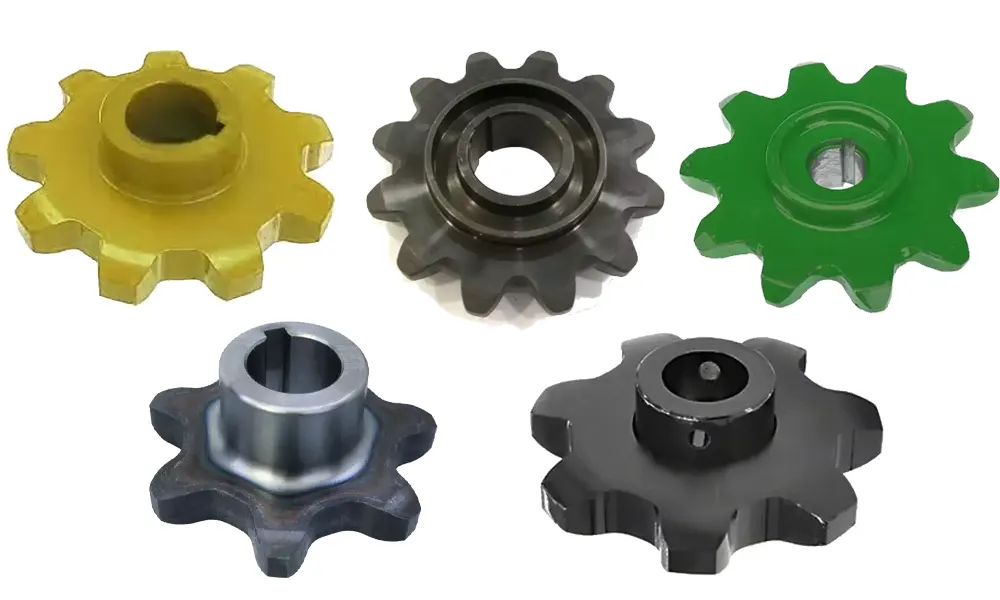
We manufacture biomass pellet mill sprockets to the specification that addresses all three failure modes simultaneously: high-temperature-rated steel alloys, deep induction hardening for abrasion resistance, and sealed drive arrangements that exclude dust from tooth contact surfaces.
️ The Three-Failure-Mode Problem in Biomass Pellet Mill Drives
Biomass pellet mills generate significant process heat — the pelletising die operates at 80–120°C and this heat conducts through the machine structure to the surrounding chain drives. Sprocket tooth flanks that undergo repeated thermal cycling (heating during operation, cooling during shutdown) accumulate surface fatigue damage through a mechanism called thermal shock cracking — fine cracks that initiate at the surface where the temperature gradient is steepest. Sprockets manufactured from alloy steel with appropriate tempering temperature can operate up to 150°C without thermal fatigue in the normal cycling range.
Ground crop residue — wheat straw, canola stubble, and sawmill fines — generates particles in the 50–200 micron range that are predominantly silica and cellulose. These particles permeate the entire pellet mill building and deposit on all exposed surfaces including sprocket teeth and chain rollers. The silica fraction is harder than the steel tooth surface and acts as an abrasive compound at the roller-tooth contact point. Induction-hardened tooth flanks at HRC 52–56 resist silica abrasion 3–4 times better than standard unhardened carbon steel at the same operating temperature.
The combination of elevated temperature and vibration from the pellet press dramatically accelerates the aging of rubber seals in chain pins and bushing bores. Failed seals allow biomass dust to enter the pin-bushing interface, converting a lubricated bearing into an abrasive grinding environment. Chains with high-temperature-rated Viton or PTFE seals maintain seal integrity at 100°C operating temperatures where standard NBR rubber seals begin to harden and crack.
Most agricultural sprocket specifications do not account for operating temperature because most field machinery operates at near-ambient temperature. In a biomass pellet mill, the chain drive is enclosed in a hot, dusty enclosure where ambient temperature around the chain may reach 70–90°C during continuous production runs. At 90°C, the fatigue limit of standard SAE 1045 carbon steel is approximately 15% lower than at 20°C, and mineral oil lubricant viscosity has dropped to the point where the hydrodynamic film at the roller-tooth contact is insufficient. Both the steel grade and the lubricant must be specified for elevated operating temperature — not ambient.
⚙️ Drive Positions in Biomass Pellet Mills
Drive the pellet press ring die from the main motor gearbox. The highest-load position on the machine — sustained high torque through the entire production run. Temperatures at this position reach 80–100°C. SAE 4140 alloy steel with induction hardening to HRC 52–56 and tempering temperature rated for 150°C service is the correct specification.
Drive the forced feeder that delivers conditioned biomass into the press chamber, and the conditioner that mixes steam with the raw material. These positions operate at temperatures of 60–80°C in the steam-and-dust environment of the conditioner. Phosphate or zinc-nickel surface treatment in addition to hardened teeth resists the combined steam-moisture and dust-abrasion attack.
Drive the feed auger that conveys raw biomass from the receiving hopper to the conditioner inlet. Lower temperature than the press drive but high abrasive dust exposure from the raw material stream. Induction-hardened case specification with sealed roller chain is appropriate.
Drive the counterflow cooler belt and the discharge screw after the pelletising press. These positions operate at lower temperature (40–60°C) but in heavy fine-pellet dust. Standard induction-hardened specification with sealed roller chain and regular dust blowdown maintenance.
Biomass Pellet Mill Sprocket Specification Reference
| Position | Chain Standard | Steel Grade | Hardness | Temp. Rating | Surface Treatment | Chain Seal Type |
|---|---|---|---|---|---|---|
| Main press drive | ANSI 100 or ANSI 120 double-strand | SAE 4140 alloy | Induction hardened HRC 52–56 | 150°C continuous | Zinc-nickel + induction hardened | Viton / PTFE high-temp sealed chain |
| Forced feeder / conditioner | ANSI 80 double-strand | SAE 4140 alloy | Induction hardened HRC 50–54 | 120°C continuous | Zinc-nickel plated | High-temp sealed chain recommended |
| Infeed auger | ANSI 60 or ANSI 80 | SAE 1045 carbon | Induction hardened HRC 48–52 | 80°C | Phosphate or Zn-Ni | Sealed roller chain |
| Pellet cooler / discharge | ANSI 60 single or double | SAE 1045 carbon | Case hardened HRC 45–52 | 60°C | Phosphate coated | Standard or sealed roller |
Selecting the Right Specification for Your Pellet Mill
Use an infrared thermometer to measure the chain and sprocket temperature during steady-state production — not at startup. The temperature at each drive position determines the minimum steel alloy grade and lubricant specification. Press drive positions above 80°C require SAE 4140 alloy and high-temperature synthetic lubricant as the minimum. Positions above 100°C require confirmation of the tempering temperature of the steel grade.
Standard NBR rubber seals in chain pins begin to harden and crack above 80°C. For main press drive and conditioner drive positions above 80°C, specify chain with Viton (FKM) or PTFE seals rated for 150°C continuous service. Chain seal integrity is the primary determinant of how long the lubricant film survives inside the pin-bushing interface at elevated temperature.
Biomass dust accumulation on sprocket teeth and in chain housings is the primary abrasion-accelerating mechanism. Schedule compressed-air blowdown of all chain drives at the end of each production shift — before the machine cools, while the dust is still loose rather than packed by condensation cooling. Regular blowdown can extend sprocket service life by 40–60% compared to allowing dust accumulation to pack into tooth contact zones.
Mineral oil lubricants designed for ambient agricultural operation lose viscosity rapidly above 60°C and oxidise at elevated temperatures, forming deposits in chain joints that increase friction rather than reducing it. Specify synthetic polyalphaolefin (PAO) or polyurea-based lubricant rated for 150°C service at all chain drive positions in the pellet mill building. Apply at the scheduled maintenance interval — not whenever the chain appears dry.
Customer Cases
A Riverina wheat straw pellet operation was experiencing main press drive sprocket tooth flank cracking after 4–6 months of operation — diagnosed as thermal fatigue from repeated 80°C–25°C cycling. After upgrading to our SAE 4140 induction-hardened sprockets with high-temp synthetic lubricant, the press drive completed a full 14-month production year without tooth cracking. “The thermal fatigue diagnosis was the key — we had been replacing the sprockets on a wear schedule when the actual failure was temperature-driven cracking. Your specification addressed the actual failure mode and the result has been a 3× improvement in service life.” ⭐⭐⭐⭐⭐
A Queensland bagasse pellet plant running continuous production sourced our full feeder and conditioner sprocket range with zinc-nickel plating and Viton-sealed chain. “The steam-and-dust environment in our conditioner section was destroying standard sprockets within 3 months. Your zinc-nickel plated conditioner drive sprockets have now run for 11 months without any surface degradation — the plating appears intact under our regular maintenance inspection.” ⭐⭐⭐⭐⭐
A Bavarian sawmill offcut pellet producer sources our main press drive sprockets in SAE 4140 specification. “Your documentation standard — Charpy impact test at both 20°C and 80°C, induction hardening depth profile, and tempering temperature certification — is the material specification evidence our engineering team required before approving a non-OEM drive component for the main press. This level of documentation is not available from most aftermarket suppliers.” ⭐⭐⭐⭐⭐
An Iowa corn stover and switchgrass pellet facility sources our feeder auger and infeed sprocket range. “The dust abrasion in our raw material infeed section is severe — silica from the corn stover soil contamination is harder than we anticipated. Your induction-hardened infeed auger sprockets have reduced tooth wear rate to one-third of what we experienced with the standard carbon steel parts we used initially.” ⭐⭐⭐⭐⭐
A Dutch agricultural residue pellet cooperative sources our complete drive sprocket range for their pellet line. “Your combination of SAE 4140 alloy steel, induction hardening, and Viton-seal chain chain recommendation for our press drive was exactly the specification our pellet plant engineer had been trying to source. The complete matched-specification recommendation — sprocket, chain, lubricant — was something no other supplier offered.” ⭐⭐⭐⭐⭐
Complete Your Pellet Mill Drive System
S-type, CA-type, and ANSI roller chains matched to every sprocket in our range — same standards, same quality, same manufacturer.
Explore Chains →
⚡ PTO Shafts & Drivelines
T-series and wide-angle CV drivelines that deliver tractor PTO power into every implement chain drive we serve.
Explore Drivelines →
⚙️ Agricultural Gearboxes
Right-angle bevel and parallel-shaft gearboxes forming the upstream drive stage for every PTO-powered chain system.
Explore Gearboxes →
❓ Frequently Asked Questions
Specify High-Temperature Sprockets for Your Biomass Pellet Mill
Tell us your pellet mill brand, the operating temperature at each chain drive position, and the biomass feedstock — we will recommend the correct alloy grade, hardness, seal type, and lubricant specification for each position. Charpy impact and thermal fatigue documentation available. 30–50% below OEM pricing.