316 Stainless and Marine-Grade Polymer Sprockets for Aquaculture Automatic Feeder Systems
Automatic feed delivery systems at Australian salmon farms in Tasmania and South Australia, and oyster and abalone operations along the NSW and WA coastlines, operate in the harshest corrosive environment that any agricultural drive component encounters. The combination of continuous saltwater spray, high relative humidity at 95–100%, chloride concentrations of 15,000–35,000 ppm in coastal air, and the biologically active marine fouling environment means that standard carbon steel sprockets have a service life measured in weeks — not seasons — before corrosion renders them mechanically unreliable.
The failure is not gradual: saltwater corrosion of standard steel sprockets proceeds through pitting corrosion — small, deep holes that initiate at grain boundaries and defect sites — which undermines the tooth root cross-section without producing visible surface rust in the early stages. A sprocket that appears lightly rusted on its surface may have lost 20–30% of its root fillet cross-section to subsurface pitting, making it susceptible to sudden brittle fracture at a load fraction of its nominal rating.
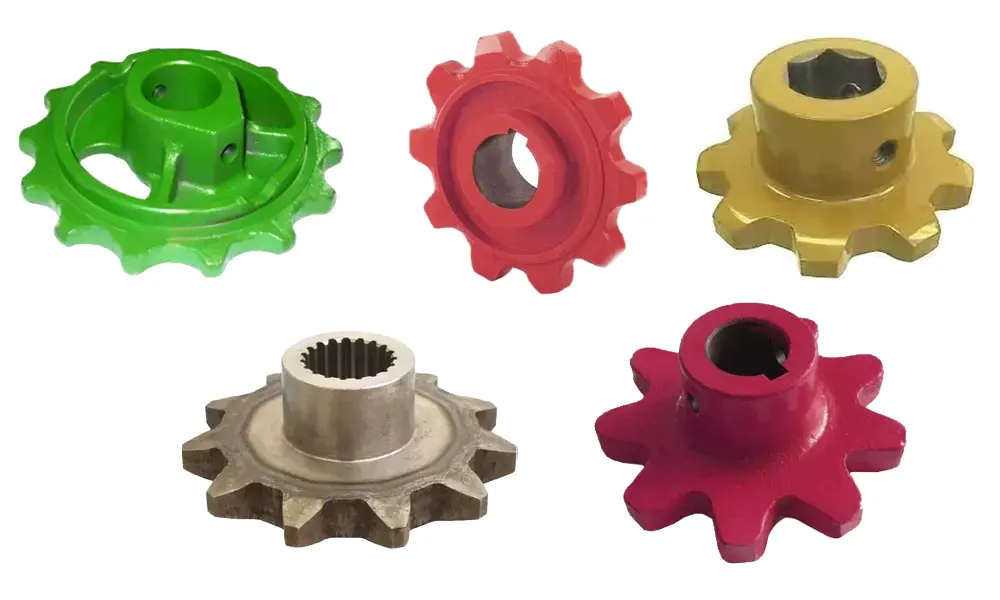
We supply aquaculture feeder drive sprockets in two marine-grade specifications that eliminate the corrosion failure mode: 316 stainless steel for metallic precision-drive positions, and glass-fibre-reinforced nylon (PA66-GF30) for light-duty drive positions where non-metallic specification eliminates all corrosion risk. Both specifications are manufactured to the same chain-standard pitch accuracy as our steel agricultural range.
Understanding Marine Corrosion — Why Only 316 SS is Adequate for Saltwater Contact
Chloride ions penetrate the passive oxide layer on stainless steel and initiate pitting corrosion in what is called localised depassivation. Once a pit initiates, the local chemistry within the pit becomes highly acidic (pH 2–3), creating an autocatalytic process that drives the pit deeper and wider regardless of the surface condition of the surrounding metal. 304 stainless steel, with 18% chromium and no molybdenum, is susceptible to chloride pitting at seawater concentrations. 316 stainless, with 16% chromium and 2–3% molybdenum, resists chloride pitting initiation at seawater concentrations through the passivating effect of molybdenum on the oxide layer.
Crevice corrosion occurs in the narrow gap between the sprocket hub bore and the shaft, where stagnant saltwater creates a depleted oxygen zone that cannot sustain the passive oxide layer. Even 316 SS can suffer crevice corrosion in tightly-fitted bore-shaft interfaces in continuous saltwater immersion. We address this through hub bore surface finish specifications that minimise the crevice geometry and through specifying a light interference fit rather than clearance fit at the bore-shaft interface.
When a stainless steel sprocket contacts a different metal — aluminium frame, carbon steel shaft, or bronze bushing — a galvanic cell forms in the saltwater electrolyte. The less noble metal (typically the steel shaft or aluminium frame) corrodes preferentially at the contact point. We specify 316 SS sprockets with compatible bore and hub materials to prevent galvanic couples, and recommend specifying the shaft material before confirming bore finish.
Marine barnacles, mussels, and biofilm organisms colonise stationary metal surfaces in aquaculture environments. The biofilm layer creates local anaerobic zones where sulphate-reducing bacteria produce hydrogen sulphide — a potent corrosive agent that attacks stainless steel through microbially induced corrosion (MIC). Regular cleaning cycles using food-safe descaling agents remove biofilm before MIC can initiate.
The distinction between 304 and 316 stainless is critical in aquaculture environments and cannot be dismissed as a conservative over-specification. At the chloride concentrations found in seawater (approximately 19,000 mg/L chloride), 304 SS has a Critical Pitting Temperature (CPT) of approximately 15°C — meaning that at temperatures above 15°C, which includes all of Tasmania’s and South Australia’s summer operating period, 304 SS will develop pitting corrosion in direct seawater contact within months. 316 SS has a CPT of approximately 30°C in seawater — safely above the operating temperatures of all Australian aquaculture environments. This 15°C difference in CPT is the engineering reason that 316 SS is the mandatory specification, not an optional upgrade, for aquaculture contact sprockets.
⚙️ Drive Positions in Aquaculture Automatic Feeder Systems
Drive the feed auger that conveys pelletised feed from the hopper to the distribution blower or direct discharge point. The auger operates intermittently — typically in 5–30 second discharge pulses — at moderate torque. These sprockets are in contact with dry pellet feed and moist coastal air, making 316 SS the correct specification. The auger drive is the most likely position to cause feed delivery failure if a sprocket corrodes and fails during a scheduled feeding cycle.
Drive the air blower that delivers pellet feed to individual cage feeding points through pneumatic pipework. These positions operate continuously at moderate speed. The blower is typically mounted on the main feeder barge in direct marine air exposure — 316 SS specification throughout is required.
Drive the agitator inside the feed hopper that prevents pellet bridging and ensures consistent feed flow to the auger inlet. These positions see low torque but are in direct contact with feed pellets and the moist, salt-laden air inside the hopper. Nylon (PA66-GF30) sprockets are an excellent specification here — they are completely corrosion-proof and food-safe, with no risk of metal contamination of the feed.
Drive the cable or chain systems that position the feeder relative to the fish cage. These are the lowest-load positions on the system but are continuously exposed to seawater spray and intermittent immersion during rough conditions. 316 SS with sealed bearing hubs is the recommended specification.
Aquaculture Feeder Sprocket Specification Reference
| 위치 | Chain Standard | 재료 | Corrosion Mechanism | Why This Specification | Service Life Target |
|---|---|---|---|---|---|
| Pellet auger drive | ANSI 40 or ANSI 50 | 316 스테인리스강 | Chloride pitting in coastal air | Mandatory 316 SS for saltwater-air chloride levels | 5~8년 |
| Blower drive | ANSI 60 single-strand | 316 스테인리스강 | Chloride pitting, marine fouling | 316 SS + regular descaling — only viable long-term spec | 5~8년 |
| Hopper agitator | ANSI 35 or ANSI 40 | PA66-GF30 Nylon | No corrosion — polymer immune | Zero corrosion risk + food-safe + no metal contamination of feed | 3–5 years (wear-limited) |
| Pontoon / barge drive | ANSI 40 or ANSI 50 | 316 스테인리스강 | Chloride pitting + immersion | 316 SS with sealed hub — only option for intermittent immersion positions | 4–6 years |
| Feed distribution pipeline drive | ANSI 40 (small) | 316 SS or PA66-GF30 | Moist coastal air | 316 SS for metallic drives; nylon for light-duty distribution valves | 5–8 years (SS); 3–5 years (nylon) |
♻️ Marine-Grade Nylon Sprockets — When Polymer Outperforms Steel
Glass-fibre-reinforced nylon (PA66-GF30) sprockets are the technically correct specification for aquaculture feeder positions that combine all three of the following characteristics: light duty (below 200 N·m peak torque), low speed (below 200 RPM), and direct contact with fish feed or feed water that requires zero metallic contamination risk. In these positions, nylon outperforms 316 SS in several important respects:
- Zero corrosion under any marine exposure level: PA66-GF30 nylon is completely immune to saltwater, chloride pitting, and galvanic corrosion. A nylon sprocket in a feeder hopper cannot fail through corrosion regardless of the marine environment intensity — the only failure mechanism is mechanical wear, which progresses predictably and visibly.
- Silent operation in direct feed contact zones: Nylon sprockets running on stainless chain produce dramatically lower operating noise than steel-on-steel combinations. In aquaculture feeding systems where acoustic disturbance of fish during feeding can affect feeding behaviour, quiet drive systems contribute to feed conversion efficiency.
- Lighter weight for pontoon-mounted feeders: PA66-GF30 nylon has a density of approximately 1.35 g/cm³ versus 8.0 g/cm³ for 316 SS — roughly 6× lighter. For pontoon-mounted feeders where equipment weight affects draft, nylon sprockets in the light-duty distribution positions meaningfully reduce the total feeder head weight.
- Food-safe certification: Our PA66-GF30 nylon compound is manufactured from food-contact-approved base resins. The material is FDA and EU food contact compliant — relevant for direct feed-contact positions in accredited salmon and prawn farm operations.
고객 사례
A Huon Valley salmon aquaculture operation running 12 automatic feeder barges replaced all feeder auger and blower drive sprockets with our 316 SS range after persistent corrosion failures with 304 SS and carbon steel components. “We had tried 304 SS and it pitted within 8 months in the Huon estuary salt environment — exactly as your CPT analysis predicted. Your 316 SS auger drive sprockets have been running for 22 months without a single corrosion indication on any tooth surface. This is the specification the aquaculture industry should have been using from the beginning.” ⭐⭐⭐⭐⭐
A Coffin Bay oyster operation running pontoon-mounted automatic feeders specified our 316 SS pontoon drive sprockets and PA66-GF30 nylon hopper agitator sprockets. “The nylon sprockets in the hopper agitator position are working perfectly after 18 months — no wear visible on the teeth and obviously no corrosion. The silent operation is an added benefit in the feeding area. The 316 SS pontoon drive sprockets are also performing as expected in the direct sea spray environment.” ⭐⭐⭐⭐⭐
A Norwegian Atlantic salmon operation running large-scale feeder systems sources our 316 SS auger and blower drive sprockets. “Norwegian aquaculture regulations require documented material specifications for all components in contact with fish feed or in the feeder water zone. Your 316 SS mill certificates and the PA66-GF30 food-contact compliance documentation satisfy our regulatory requirements without additional testing.” ⭐⭐⭐⭐⭐
A Los Lagos salmon farming operation running 30 feeder stations in high-salinity fjord conditions sources our full 316 SS feeder sprocket range. “The combination of cold fjord water, tidal variation, and the biological fouling in our operating area creates a very demanding corrosion environment. Your 316 SS sprockets with the molybdenum content confirmed on the mill certificate are the only specification we have found that provides reliable multi-year service in these conditions.” ⭐⭐⭐⭐⭐
A Port Lincoln abalone operation running land-based recirculating system feeders specifies our 316 SS auger drive sprockets and nylon distribution sprockets throughout. “Port Lincoln’s seawater is high-salinity even by Australian standards. Your CPT analysis correctly identified that 304 SS would fail here — 316 SS was the correct call and the performance has been exactly as your engineering team predicted.” ⭐⭐⭐⭐⭐
Complete Your Aquaculture Feeder Drive System
S형, CA형 및 ANSI 롤러 체인은 당사 스프로킷과 동일한 피치 표준으로 제조되며, 검증된 매칭 세트로 제공됩니다.
체인 살펴보기 →
⚡ PTO 샤프트 및 구동계
T 시리즈 및 광각 CV 드라이브라인은 트랙터 PTO 동력을 당사가 제공하는 모든 작업기 체인 및 스프로킷 구동 장치에 연결합니다.
구동계 살펴보기 →
⚙️ 농업용 기어박스
PTO 구동 체인 시스템의 상류 구동 단계를 구성하는 직각 베벨 기어박스와 평행축 기어박스.
기어박스 살펴보기 →
❓ 자주 묻는 질문
Get 316 SS and Marine-Grade Nylon Sprockets for Your Aquaculture Feeder
Tell us your feeder make and model, the operating positions you need to specify, and whether your site is open-ocean, estuarine, or land-based recirculating system — we will recommend 316 SS vs nylon for each position and supply with full regulatory compliance documentation. 30–50% below OEM and equipment manufacturer pricing.